
Art as Structured Navigation
Resistance, Affordance, and Aesthetic Encounter

Note: The Framework of Orientational Realism presented here, has evolved following its application to Mathematics and Meaning. In response to critiques regarding the unnecessary reification of "coherence landscapes" and the argument that affordance should be viewed as direct perception, the model has been refined. I have integrated the concepts of resistance and tensegrity, which are particularly applicable to the study of Art. Crucially, coherence landscapes are not pre-existing structures; they are dynamically co-created through participation.
I. The Question That Won’t Stay Answered
What is art?
We’ve been asking for millennia and never quite landing. Plato thought art was imitation twice removed from truth. Tolstoy said it was the transmission of feeling. Duchamp placed a urinal in a gallery and dared us to explain why it wasn’t art. A century later, we’re still arguing.
Maybe the question resists answer because we’ve been looking in the wrong direction—at the object instead of the encounter, at the noun instead of the verb.
The philosopher John Dewey argued exactly this. In Art as Experience, he insisted that the painting-on-the-wall is not yet “the work of art” in the full sense. The work of art happens when that object functions in experience—when a living perceiver engages it, actively and attentively. Art is not primarily a thing. It is a kind of experience.
What if we take this seriously? What if art is a trace—the crystallized wake of someone’s passage through difficulty, rendered into a form that lets others make the same passage?
This essay proposes a way of seeing art that draws on ecological psychology, phenomenology, and Dewey’s philosophy of experience. In this view, art is what happens when skilled navigation becomes shareable. And appreciating art is not receiving a message but entering a structured space where your own navigation becomes possible.
To understand this, we need three ideas: resistance, affordance, and tensegrity.
II. The World Pushes Back
Start with something simpler than art. Push against a wall. It pushes back. Walk toward a cliff’s edge. Something in you registers: not that way. The world resists.
This resistance isn’t arbitrary. It has pattern. Consider learning to ride a bicycle. At first, the bicycle seems to resist everything you do—it wobbles, tips, refuses to go straight. But the resistance has structure. Lean too far left and you fall left. Pedal too slowly and you lose stability. As you learn its patterns, you begin to navigate. Eventually, you don’t think about it at all—your body knows the patterns so well that navigation becomes seamless.
This is what learning always is: developing sensitivity to resistance, until you can move through it with skill. Related: Learning is not supposed to be fun
The phenomenologist Martin Heidegger made a related observation: we don’t encounter the world as neutral data to be processed. We encounter it as equipment that matters to us. When equipment works, we hardly notice it; we’re absorbed in what we’re doing. But when equipment fails—the hammer breaks, the brush splays—the world suddenly shows up as resistant, demanding reorientation. Heidegger called this breakdown: the moment when smooth coping is interrupted and we must navigate consciously again.
The physicist calls resistance constraint. The carpenter calls it the grain of the wood. The musician calls it what the harmony wants. In every domain, masters are those who have developed attunement—the capacity to perceive finer distinctions of how things push back and what they allow.
III. Affordances: What Things Are For
The ecological psychologist James Gibson noticed something important about perception: we don’t see the world as neutral data that we then interpret. We see it as affordances—possibilities for action.
The cup is graspable. The path is walkable. We don’t first see “a flat horizontal surface at knee height” and then calculate that it affords sitting. We see something to sit on.
Affordances are relational—they depend on what kind of creature you are. A tree affords climbing for a child but not for a fish. The affordance exists in the relationship between perceiver and perceived.
This matters for art. When you stand before a painting, you perceive it as affording certain kinds of looking, certain movements of attention. The dark area draws your eye. The bright spot holds it. The composition moves you through itself. These are affordances—not added by your interpretation but perceived directly.
The novice and the master stand before the same painting but perceive different affordance landscapes. The master sees more—more paths, more invitations, more structure. This developed sensitivity is attunement. It’s real, it’s learnable, and it’s what expertise actually is.
IV. Navigation and Tensegrity
If the world has patterned resistance, and if we perceive affordances directly, then our fundamental relationship to reality isn’t observation—it’s navigation.
Dewey captured this with his concept of doing and undergoing. Experience isn’t private mental content. It’s an ongoing loop: you do something (act, explore, attend), and you undergo something (the world pushes back, responds, surprises). Meaning arises in this exchange. Dewey distinguished the constant flow of life from a bounded, meaningful episode he called “an experience”—one with structure: pressures, obstacles, rhythm, release, culminating in consummation. Art creates the conditions for such experiences.
Think of a surfer. The wave is not an object to be contemplated; it’s a dynamic pattern to be navigated. The surfer reads the water—feels where the energy is building, anticipates the break. Get it right and you ride; get it wrong and you wipe out. The meaning arises in the encounter—in the relationship between the surfer’s body and skill and the wave’s structure and force.
This is how we should think about art. The artist navigates resistances: the medium, the subject, the tradition. The navigation leaves traces—the artwork. The appreciator navigates those traces, finding their own path through the structure the artist created.
One more concept: tensegrity, from Buckminster Fuller. Tensegrity describes structures that maintain their integrity through tension—rigid struts held in place by tensioned cables. Remove the tension and everything collapses. The structure stands not despite the tension but because of it.
Great art works this way. It doesn’t resolve its tensions by eliminating them. It holds them. The tragedy shows both the hero’s nobility and their destruction. The jazz improvisation holds structure and freedom in the same gesture. The poem holds contradictory emotions without forcing a conclusion.
We might call this tensional integrity: coherence achieved through the productive holding of opposing forces.
Pseudo-art—propaganda, kitsch, formula—collapses into one pole. Only the pleasant feeling. Only the correct message. The apparent unity is achieved by eliminating complexity. The tell: it cannot survive scrutiny. Look once and you’ve seen it.
Great art rewards return because its tensional structure is genuinely complex. Each navigation finds something new.
V. What the Artist Does
The artist works at the intersection of multiple resistances.
The resistance of the medium. Paint wants to drip. Marble has veins and fracture planes. The medium is not passive material; it’s a partner in a conversation, pushing back with its own logic. Mastery is not dominion but dialogue.
The resistance of the subject. Whatever the artist is trying to articulate—grief, morning light, the tension between freedom and belonging—has its own structure. Some renderings betray it. Some flatten it. The subject resists being falsified.
The resistance of form. Genres, conventions, traditions, the internal logic of the developing work—these create structure the artist navigates through or against. And as the work develops, it accumulates its own resistance. The first brushstroke constrains the second.
Dewey was critical of theories that reduce art to “expression of feelings.” Expression is achieved through craft: selecting, organizing, and transforming materials so that a meaning can be experienced by others. The emotion is not copied into the viewer’s head; it is made available through a medium.
Michelangelo said: “I saw the angel in the marble and carved until I set him free.”
Neither pure projection nor pure discovery. The angel was somehow there—in the grain and fault lines. But it also had to be freed—navigated into visibility.
VI. Light on the Epte: A Sustained Example
Camille Pissarro painted Bords de l’Epte à Eragny, soleil couchant—the banks of the Epte river at sunset—sometime after 1884. The Epte was a modest river, not dramatic. Pissarro returned to it endlessly.
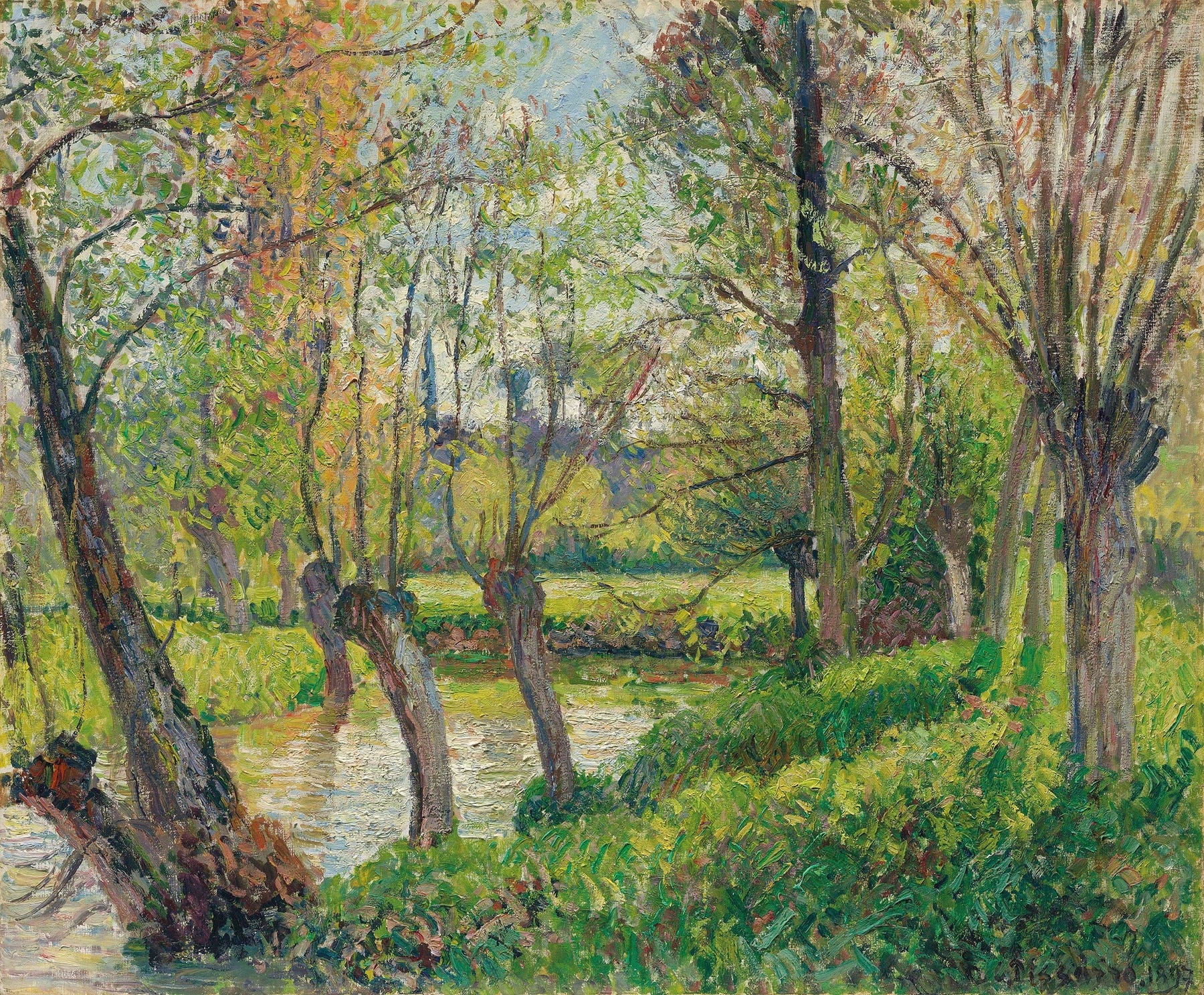
The painting shows trees along the riverbank, their forms reflected in water, the sky warming into ochres and soft oranges. The brushwork is visible—each stroke a decision, a response to what the paint and the light would allow.
The Resistances Pissarro Navigated
The resistance of dying light. A sunset doesn’t hold still. Pissarro worked against time itself—the subject was disappearing as he painted it. The broken brushwork of Impressionism wasn’t stylistic affectation—it was the only honest response to a subject that refused to be fixed.
The resistance of the medium. The thick strokes that catch light from the gallery wall are negotiations between what Pissarro wanted and what the paint would do. The reflections in the river aren’t depicted so much as suggested—broken horizontal strokes that produce the effect of reflection.
The resistance of the familiar. Pissarro painted this river for nearly twenty years. The danger of familiarity is blindness. But he kept looking, kept finding what he hadn’t seen before.
What the Painting Holds
Warmth and coolness. The sky carries heat—ochres, soft oranges. But the shadows are cool, the water holds blue and green. The painting holds both.
Solidity and dissolution. The trees have weight—rooted, present. But their edges blur into the sky. Pissarro holds form and formlessness in suspension.
Presence and transience. The painting makes the moment vivid—you’re there, in the light. But it’s a sunset: what’s here is leaving. The poignancy is in the holding.
A lesser painting would collapse one pole. Pissarro’s keeps everything alive by keeping everything in tension.
The Connection to Pissarro
That experience cannot be transmitted to us. We cannot feel what he felt.
But the painting is the trace of his navigation. The brushstrokes are decisions—this color here, this direction of stroke. Each decision responded to resistance. The accumulation is a structure, and the structure persists.
We navigate the structure. Our experience is ours. But the path we walk is the path Pissarro made.
This is the connection. Not transmission but shared navigation. Not his experience in our heads but our experience in his wake.
VII. Expanding the Circle: Limit Cases
The essay has described a core case: the painter navigating material resistance. But how far does this extend?
The Appreciator’s Navigation
When you stand before Pissarro’s sunset, you don’t just receive information. You navigate. Your eyes move through the composition—drawn here, held there. The painting resists certain kinds of looking: glance quickly and you see nothing. It rewards others: slow attention, peripheral awareness, patience.
Dewey saw clearly that the perceiver is not passive. Perception is a form of doing. The viewer’s trained attention “brings the work to life”—not by adding something absent, but by completing a circuit the work makes possible.
If appreciation is navigation, then art-making and art-receiving are continuous.
The Deaf Composer
Beethoven composed his late string quartets in complete deafness. Was he just manipulating abstract symbols?
No. He was navigating internalized resistance. He had spent decades with his hands on piano keys, his body swaying to tempo, his ears feeling the physical tension of a dominant chord that “wants” to resolve. By the time he lost his hearing, this knowledge had become so deeply part of him that he could navigate it in the dark.
Resistance can be internalized. But notice what was required: decades of prior embodied encounter. Beethoven could navigate in the dark because he had spent so long navigating in the light.
The Photographer’s Navigation
Photography seems challenging. The shutter fires in a fraction of a second. Where is the struggle?
But the photographer navigates different resistances: light and time (the decisive moment that arrives and vanishes), position and access (getting this angle on this subject), the frame (every photograph excludes infinitely more than it includes), and seeing itself (perceiving affordances invisible to the untrained eye).
The camera is a tool for navigation. The resistances are temporal and perceptual more than material—but they are real.
The Tea Master’s Navigation
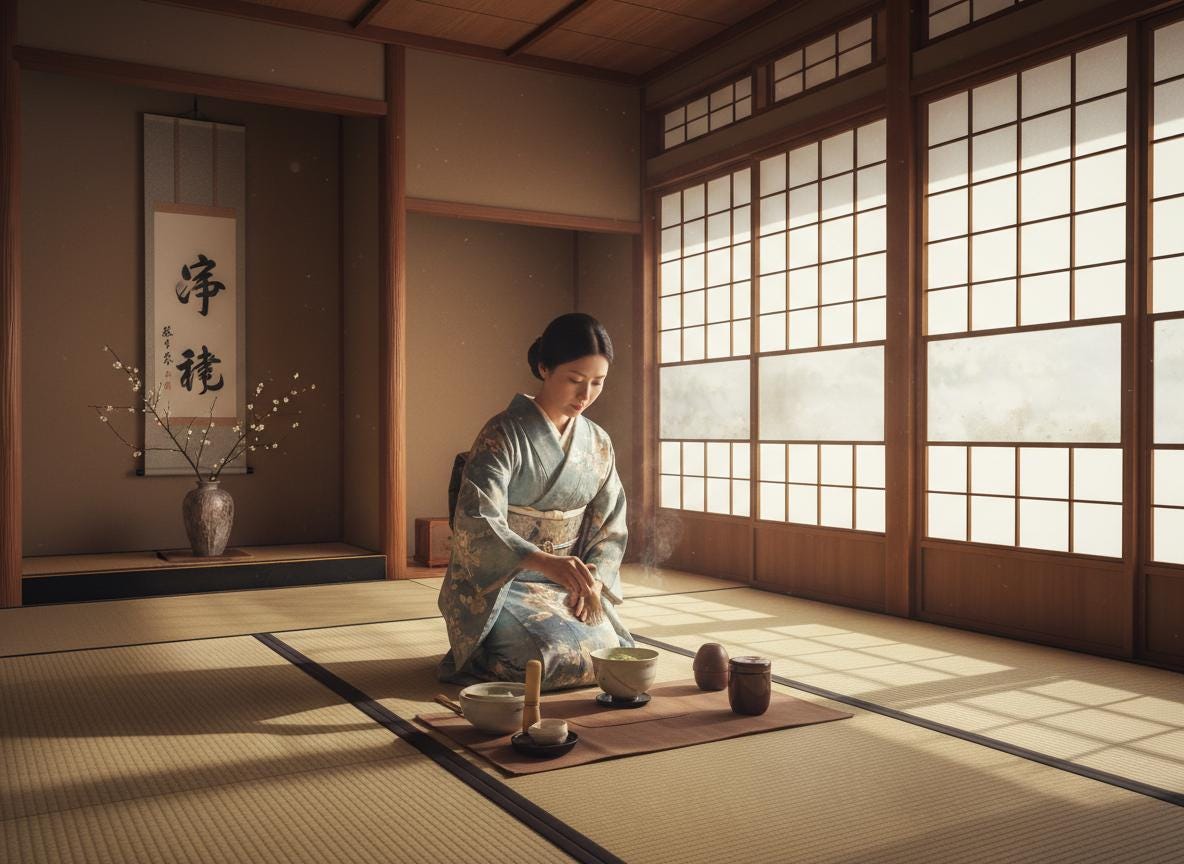
Japanese tea ceremony (chanoyu) emphasizes the resistance of space, time, and social form. The practitioner navigates a stringent environment: tatami mats constrain movement, the chashaku resists with its fragility, the whisking of matcha requires precise angles.
Unlike solitary painting, tea ceremony is collective navigation. You navigate with others in a choreographed space. The structure includes relationship itself.
VIII. The Open Question: Algorithmic Navigation
What about AI-generated images? What about prompt-crafting?
This question demands careful treatment.
What the Prompt-Crafter Does
Consider the serious prompt-crafter who iterates. They type a prompt. The model generates an image. They judge: not quite right. They refine. They generate again. They adjust.
This is a feedback loop. There is something like resistance: the model doesn’t do what you want. There is something like skill: experienced prompters perceive affordances novices miss.
If navigation means “moving through a structured space, responsive to what resists and what enables,” then prompt-crafting involves navigation.
Is the Latent Space Real?
One framework defines real as natural—the physical world of light and stone. On this view, navigating a statistical model is somehow less real.
But a more modest definition: real means reliably emergent in encounter, trans-subjectively accessible, capable of surprising us, resistant to arbitrary revision.
By this criterion, the latent space is real. It emerges reliably. Different prompters converge on similar understandings. It surprises. It resists arbitrary revision.
If the latent space is real, the distinction between prompt-crafting and traditional art-making is less sharp than it first appears.
What Remains Different?
And yet, something may be different.
What attunement develops. Pissarro developed attunement to light—transferable beyond the canvas. Does prompting skill transfer? Does it make you see the world differently? We don’t yet know.
What gets crystallized. Pissarro’s painting crystallizes his navigation through light, paint, and time. The AI-generated image crystallizes navigation through prompt-space—but also the training data’s averaged patterns. Whether this is a new kind of crystallized navigation or something categorically different remains open.
What the work opens onto. Pissarro’s sunset opens onto that light. An AI-generated “sunset” opens onto statistical patterns. But does all art need to point beyond itself? Abstract art doesn’t represent anything external.
The question of stakes. The human prompter cares. The algorithm has no stakes. But AI is developing rapidly. Embodied AI may develop something like stakes. Forms of human-AI collaboration may blur the question of “who is navigating.”
The Spectrum of Practices
Rather than a binary, we might see a spectrum:
Casual generation: Type once, accept the output. Minimal navigation.
Skilled prompting: Iterate, refine, evaluate. Genuine skill developed.
Hybrid practice: A human with developed visual attunement uses the model to externalize what they’ve learned.
Collaborative creation: Human and AI as partners—orientation and generation distributed across the system.
Future possibilities: Embodied AI, integrated systems, forms we cannot yet imagine.
The better questions: What is the prompter navigating? What attunement are they developing? Does the resulting work reward sustained attention? Does it hold tensional integrity?
IX. The Crisis of Friction
Whatever we conclude about AI art, a broader concern remains.
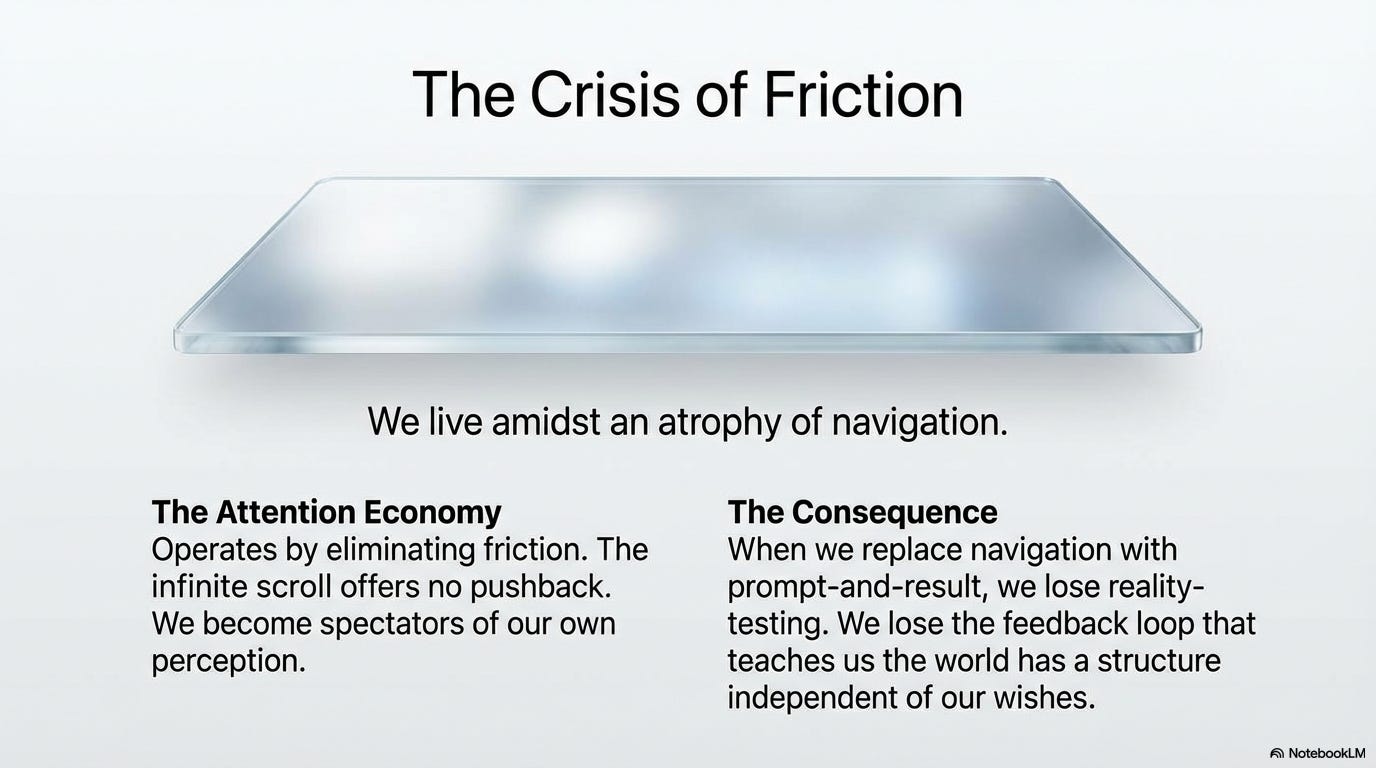
We live amidst a dissolution of resistance. The attention economy operates by eliminating friction. The scroll offers no pushback. The algorithm smooths away difficulty.
Dewey saw this coming. He argued that modern culture isolates art by treating it as precious objects for passive spectatorship—”the museum conception of art.” The digital age has intensified this severance. Streaming flattens music into “content.” Social media trains us to spectate rather than navigate.
When anyone can generate a “Pissarro-style sunset” in seconds, the specific difficulty of Pissarro’s looking becomes invisible. This isn’t wrong because machines are involved; it’s concerning because the friction that develops attunement is erased.
Navigation is how we develop reality-testing. The bicycle teaches us balance because it throws us when we get it wrong. When we replace navigation with prompt-and-result, we risk losing the feedback loop that develops attunement.
Art is an antidote. Creating art—even badly—exercises oriented perception. Appreciating art—truly appreciating—exercises the same capacity.
Kurt Vonnegut: “Practicing an art, no matter how well or badly, is a way to make your soul grow, for heaven’s sake. Sing in the shower. Dance to the radio. Write a poem to a friend, even a lousy poem.”
The question for our time is not whether to accept or reject AI in art. The question is whether we will preserve the capacity for navigation—whatever tools we use.
X. The Shared Sea
Here is what art offers:
Not content transmitted. Not beauty as decoration. Rather: structured navigation made shareable.
The artist sails difficult waters. The passage leaves structure. The structure persists, crystallized into the work. Now you sail the same waters—never the same journey, but the same sea.
Michelangelo navigated marble—and left the David. Bach navigated counterpoint—and left the Art of Fugue. Sen no Rikyū navigated season and social form—and left a tradition of presence. Pissarro navigated fading light—and left the sunset on the Epte.
The connection is real. What’s shared is structure, not content. What passes between is pattern, not experience. And this is enough.
Picasso: “Art is the lie that enables us to realize the truth.”
The “lie”—the transformation, the selection—makes the truth navigable. Reality raw is too much. The artist passes through, leaves structure, and the structure becomes a way in.
XI. Entering
We return to Pissarro’s modest painting—a small river, an ordinary sunset.
The claim here is that meaning is everywhere—that patterned resistance is not reserved for the exceptional. Pissarro found inexhaustible meaning in a modest river in the fading light of an ordinary evening.
Dewey would have approved. He insisted that the roots of art lie in everyday experience—in any episode where doing and undergoing become rhythmic, patterned, consummated. The aesthetic is not a special realm but a potential in any encounter.
If the world is flat and meaningless, Pissarro should have had nothing to paint. But the world is not flat. The light has structure. The patterns are real, waiting for the participant who will navigate them.
This is not elitist. Everyone who has sung in the shower has navigated. Everyone who has cried at a movie has entered an affordance structure and found their way through.
But the capacity can atrophy. And in these times of algorithmic smoothing—where constraints are plentiful but resistance is scarce—it is atrophying for many.
The recovery is not mysterious. Navigate. Create, even badly. Attend, even briefly. Enter the structures that masters have left. Let your perception be trained. Find that the world has grain—and learn to feel it.
The resistance is real. The patterns are real. The meaning is waiting in the encounter.
All that remains is to enter.
References
John Dewey argued that art is not primarily an object but a kind of experience—the transaction between a living perceiver and a made thing. His concepts of doing and undergoing, an experience, and consummation provide the philosophical foundation for understanding art as navigation.
Dewey, J. (1934). Art as Experience. New York: Minton, Balch & Company.
James J. Gibson developed the ecological approach to perception, arguing that we perceive affordances directly—possibilities for action—rather than processing neutral sensory data.
Gibson, J. J. (1979). The Ecological Approach to Visual Perception. Boston: Houghton Mifflin.
Martin Heidegger analyzed being-in-the-world as our primary mode of existence. His concepts of equipment and breakdown illuminate why attunement develops through encounter with resistance.
Heidegger, M. (1927/1962). Being and Time. Trans. John Macquarrie and Edward Robinson. New York: Harper & Row.
R. Buckminster Fuller developed the concept of tensegrity, providing a structural model for understanding coherence through the productive holding of opposing forces.
Fuller, R. B. (1975). Synergetics. New York: Macmillan.