
The Third Way: Mathematics as Determination in Participational Realism
The Forcing Quality of Truth

The Enduring Puzzle
In 1960, physicist Eugene Wigner published an essay that would become one of the most cited in the philosophy of mathematics. Its title posed a puzzle that remains unresolved: “The Unreasonable Effectiveness of Mathematics in the Natural Sciences.” Wigner marveled at how mathematical structures, developed purely for their internal beauty and coherence, repeatedly turn out to describe physical reality with uncanny precision.
“The miracle of the appropriateness of the language of mathematics for the formulation of the laws of physics,” he wrote, “is a wonderful gift which we neither understand nor deserve.”
This miracle suggests a question that has occupied philosophers since antiquity: What is mathematics? When a mathematician proves a theorem, are they discovering something that was already true, or are they inventing a structure that did not exist before? Is mathematics found or made?
This question is not merely academic. How we answer it shapes our understanding of mathematical knowledge, mathematical education, and the relationship between mind and reality. It bears on whether mathematical truth is objective or conventional, whether mathematical creativity is exploration or construction, and whether the universe is, at its foundation, mathematical.
For most of Western intellectual history, two broad camps have contested this terrain. Platonists hold that mathematical objects exist independently of human minds and that mathematicians discover pre-existing truths. Constructivists, formalists, and nominalists of various stripes hold that mathematics is a human creation—a language, a game, a social practice, or a useful fiction.
This essay argues that both positions capture something important but that neither is fully adequate. Drawing on the framework of Participational Realism, which I am still developing, and will be presented at a later stage, I propose a third alternative: mathematics is neither discovered nor invented but determined through constrained participation in real structures of coherence.
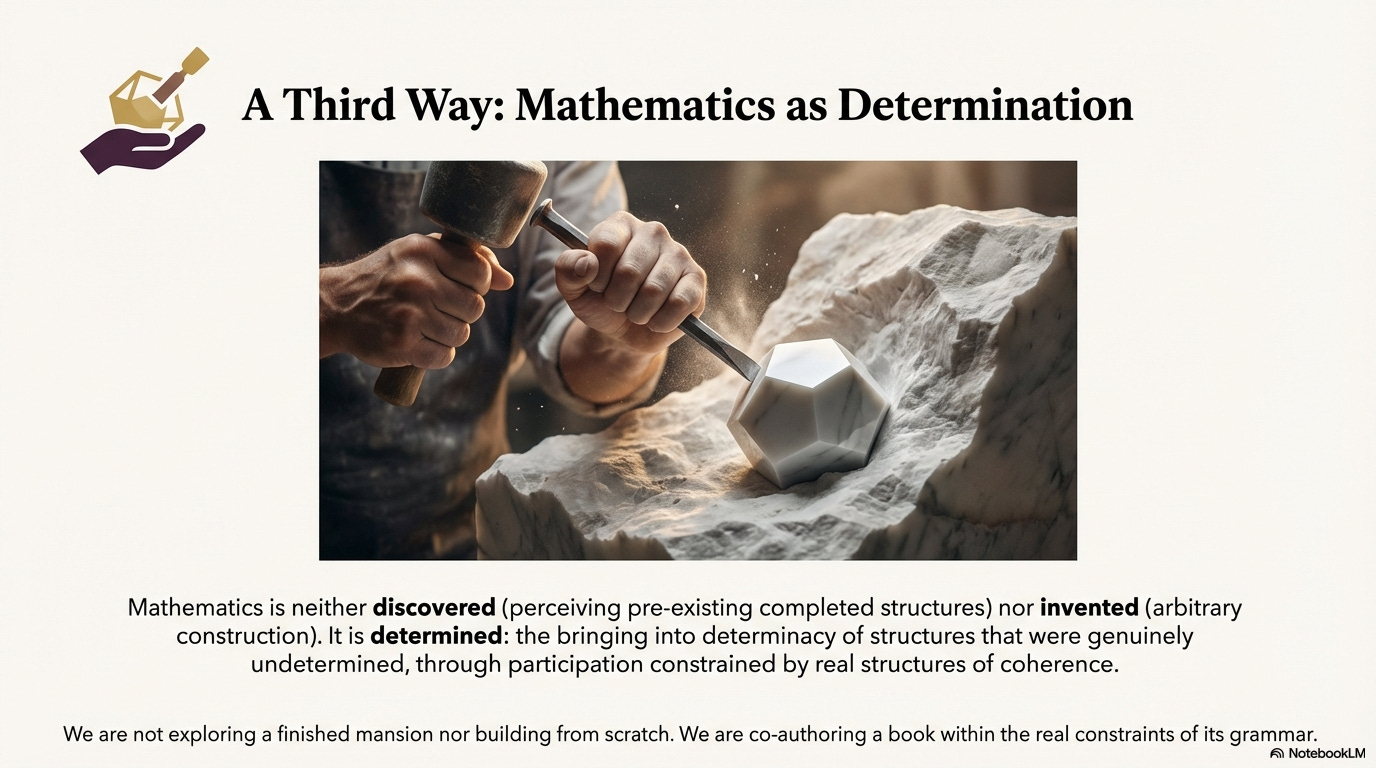
This view preserves the objectivity that Platonists rightly insist upon while accommodating the creative, constructive dimension that anti-Platonists correctly identify.
The Case for Discovery: Mathematical Platonism
The view that mathematics is discovered has ancient and distinguished roots. Plato himself, in dialogues like the Meno and the Republic, argued that mathematical objects—numbers, circles, the forms of geometric figures—exist in an eternal, unchanging realm of Forms, more real than the imperfect physical copies we encounter through the senses. Mathematical knowledge, for Plato, is recollection: the soul, having encountered the Forms before embodiment, recognizes them again when prompted by sensory experience.
In the twentieth century, this tradition found its most formidable champion in Kurt Gödel, widely regarded as the greatest logician since Aristotle. Gödel’s incompleteness theorems demonstrated that any sufficiently powerful formal system contains truths that cannot be proven within the system—a result that Gödel interpreted as evidence for mathematical Platonism. If mathematics were merely a formal game, there would be nothing beyond the rules. But the incompleteness theorems show that mathematical truth outruns any formal system we can construct. In a passage that has become a touchstone for mathematical Platonism, Gödel wrote:
“Despite their remoteness from sense experience, we do have something like a perception of the objects of set theory, as is seen from the fact that the axioms force themselves upon us as being true. I don’t see any reason why we should have less confidence in this kind of perception, i.e., in mathematical intuition, than in sense perception.”
This description of axioms that “force themselves upon us” captures something essential about mathematical experience—a phenomenological quality that Participational Realism takes seriously, even as it reinterprets its metaphysical significance.
The British mathematician G.H. Hardy expressed similar convictions with characteristic elegance in A Mathematician’s Apology (1940):
“I believe that mathematical reality lies outside us, that our function is to discover or observe it, and that the theorems which we prove, and which we describe grandiloquently as our ‘creations,’ are simply our notes of our observations.”
The legendary Hungarian mathematician Paul Erdős, who published more papers than any mathematician in history, spoke of “The Book”—an imaginary volume in which God keeps the most elegant proofs of all theorems. When Erdős encountered a particularly beautiful proof, he would say it was “from The Book.” Though Erdős was an atheist, his metaphor captured the sense that mathematical truths exist independently, waiting to be found.
Contemporary physicist and mathematician Roger Penrose has defended Platonism with vigor, arguing in The Road to Reality (2004) and elsewhere that mathematical truth is discovered, not invented, and that this has profound implications for physics and consciousness:
“Mathematical truth is not determined arbitrarily by the rules of some ‘man-made’ formal system, but has an absolute nature of its own.”
Penrose’s insistence on the “absolute nature” of mathematical truth reflects the Platonist conviction that once a structure is established within the mathematical realm, its consequences follow with objective necessity—a point that Participational Realism preserves while reconceiving its foundation.
The Evidence for Discovery
Several features of mathematical experience support the Platonist view.
The universality of mathematics. Different cultures, with no contact, have arrived at the same mathematical truths. The Pythagorean theorem was known to the Babylonians, Chinese, and Indians independently of the Greeks. This suggests that mathematicians are converging on a common, mind-independent reality rather than constructing divergent cultural artifacts.
The phenomenon of unexpected connections. Mathematical structures developed in one context repeatedly turn out to connect with structures developed in entirely different contexts. The number π, defined as the ratio of circumference to diameter of a circle, appears in probability theory (Buffon’s needle problem), number theory (the distribution of primes), and complex analysis (Euler’s identity: e^(iπ) + 1 = 0). These connections seem too systematic to be coincidental artifacts of human construction.
The experience of constraint. Mathematicians consistently report the experience of being constrained by their subject matter. They cannot make the theorems come out however they like. The great geometer Bernhard Riemann did not decide that there would be infinitely many prime numbers; he discovered that the hypothesis bearing his name (still unproven) has consequences he did not anticipate. Hardy put the point memorably:
“I have myself always thought of a mathematician as in the first instance an observer, a man who gazes at a distant range of mountains and notes down his observations.”
The Mandelbrot set. Perhaps no mathematical object better illustrates the sense of discovery than the Mandelbrot set. Defined by an almost trivially simple rule—iterate z → z² + c and ask whether the sequence remains bounded—this set contains infinite, intricate structure that no one anticipated. Zooming into its boundary reveals seahorses, spirals, and miniature copies of the whole set, all implicit in the simple generating rule. When Benoit Mandelbrot first visualized this set using computer graphics in the 1980s, he felt unmistakably that he was exploring something that existed independently of his investigation.
The Case for Invention: Formalism, Intuitionism, and Social Constructivism
Despite the power of these considerations, many mathematicians and philosophers have resisted Platonism. Their reasons are both philosophical and practical.
Formalism: Mathematics as Symbol Manipulation
David Hilbert, the dominant figure in early twentieth-century mathematics, championed formalism—the view that mathematics is, at its core, a formal game played with symbols according to specified rules. In this view, mathematical statements are not about abstract objects; they are simply strings of symbols manipulated according to syntactic rules. The “meaning” of these symbols is irrelevant; what matters is formal consistency.
Hilbert famously captured this view in a striking image:
“Mathematics is a game played according to certain simple rules with meaningless marks on paper.”
This was not dismissive; Hilbert had the highest regard for mathematics. His point was methodological: to secure the foundations of mathematics, we should treat it as a formal system and prove that system consistent. The content of mathematical statements is irrelevant to this project.
Though Gödel’s incompleteness theorems dealt a serious blow to Hilbert’s specific program, formalism as a philosophical stance retains adherents. It sidesteps the metaphysical mysteries of Platonism—how we could have epistemic access to abstract objects with which we have no causal contact—by denying that mathematics is about anything at all.
Intuitionism: Mathematics as Mental Construction
L.E.J. Brouwer, Hilbert’s great rival, proposed a radically different anti-Platonism. For Brouwer, mathematics is a construction of the human mind. Mathematical objects do not exist independently; they are brought into being by mental acts of construction. A mathematical statement is true not because it corresponds to some external reality but because it can be proven—where “proven” means constructively demonstrated.
This has dramatic consequences. For the intuitionist, the law of excluded middle (every statement is either true or false) does not hold universally in mathematics, because there may be statements for which we have neither a proof nor a refutation. The Platonist believes that every well-formed mathematical statement is determinately true or false, independent of our knowledge; the intuitionist rejects this as meaningless metaphysics.
Leopold Kronecker, a predecessor of Brouwer, expressed a famous and influential version of this constructivist attitude:
“God made the integers, all else is the work of man.”
For Kronecker, even rational and real numbers are human constructions built up from the God-given integers, and constructions like Cantor’s transfinite numbers were illegitimate.
Social Constructivism: Mathematics as Cultural Practice
More recent anti-Platonist views emphasize the social and historical dimensions of mathematics. Reuben Hersh, in What Is Mathematics, Really? (1997), argued that mathematics is
“a human activity, a social phenomenon, part of human culture, historically evolved, and intelligible only in a social context.”
In this view, mathematical objects are social constructs, like money or marriage. They are real in the sense that they have effects and structure our practices, but they are not mind-independent features of the universe. Mathematical truth is truth-relative-to-a-practice, and that practice is human, historical, and contingent.
The Evidence for Invention
Several considerations support these anti-Platonist positions.
The historical struggle for acceptance. If mathematical objects existed eternally in a Platonic realm, one might expect their “discovery” to be a matter of simply perceiving what is there. But the history of mathematics is marked by prolonged struggles over whether new entities are legitimate. Negative numbers were resisted for centuries; as late as the eighteenth century, leading mathematicians regarded them as “absurd” or “fictitious.” Complex numbers, defined as involving √(-1), were dismissed as “imaginary” (a term that stuck even as they became indispensable). Zero took centuries to gain acceptance in European mathematics. If these numbers were simply waiting to be discovered, why was the “discovery” so difficult and contested?
The role of choice and convention. Mathematical frameworks often involve choices that seem arbitrary rather than dictated by a pre-existing reality. We could define our number systems with different bases. We could work with alternative set theories (with or without the axiom of choice, with or without the continuum hypothesis). The fact that mathematicians make choices about axioms and definitions suggests construction rather than discovery.
The Benacerraf problem. Philosopher Paul Benacerraf posed a sharp dilemma for Platonism in his influential 1973 paper “Mathematical Truth.” If mathematical objects are abstract, causally inert, and outside space and time, how could we ever come to know anything about them? Our standard accounts of knowledge involve some causal connection between the knower and the known—perception, testimony, inference from evidence. But abstract objects cannot cause anything. Platonism seems to make mathematical knowledge impossible, yet mathematical knowledge is the most certain knowledge we have.
The Tensions and Limits of Both Views
Both Platonism and its rivals face serious difficulties.
Platonism struggles to explain how we gain epistemic access to abstract objects. Gödel’s appeal to mathematical “intuition” or “perception” is suggestive but obscure. What faculty could perceive objects with which we have no causal contact? The metaphysics is hard to accept, and the epistemology is left mysterious.
Anti-Platonist views have their own problems. If mathematics is merely formal symbol manipulation, why is it so effective in describing physical reality? If it is mental construction, why do different minds construct the same mathematics? If it is a social convention, why can we not simply convene a conference and decide that the Riemann hypothesis is true?
The difficulty is this: mathematics seems to have an objectivity that resists reduction to human activity, yet it also seems to involve genuine creativity that resists reduction to passive discovery. Mathematicians experience both constraint and freedom. They cannot make the theorems come out however they like, yet they also exercise genuine creativity in devising proofs, formulating concepts, and constructing new structures.
This duality is visible in the historical examples that both sides cite. Consider non-Euclidean geometry.
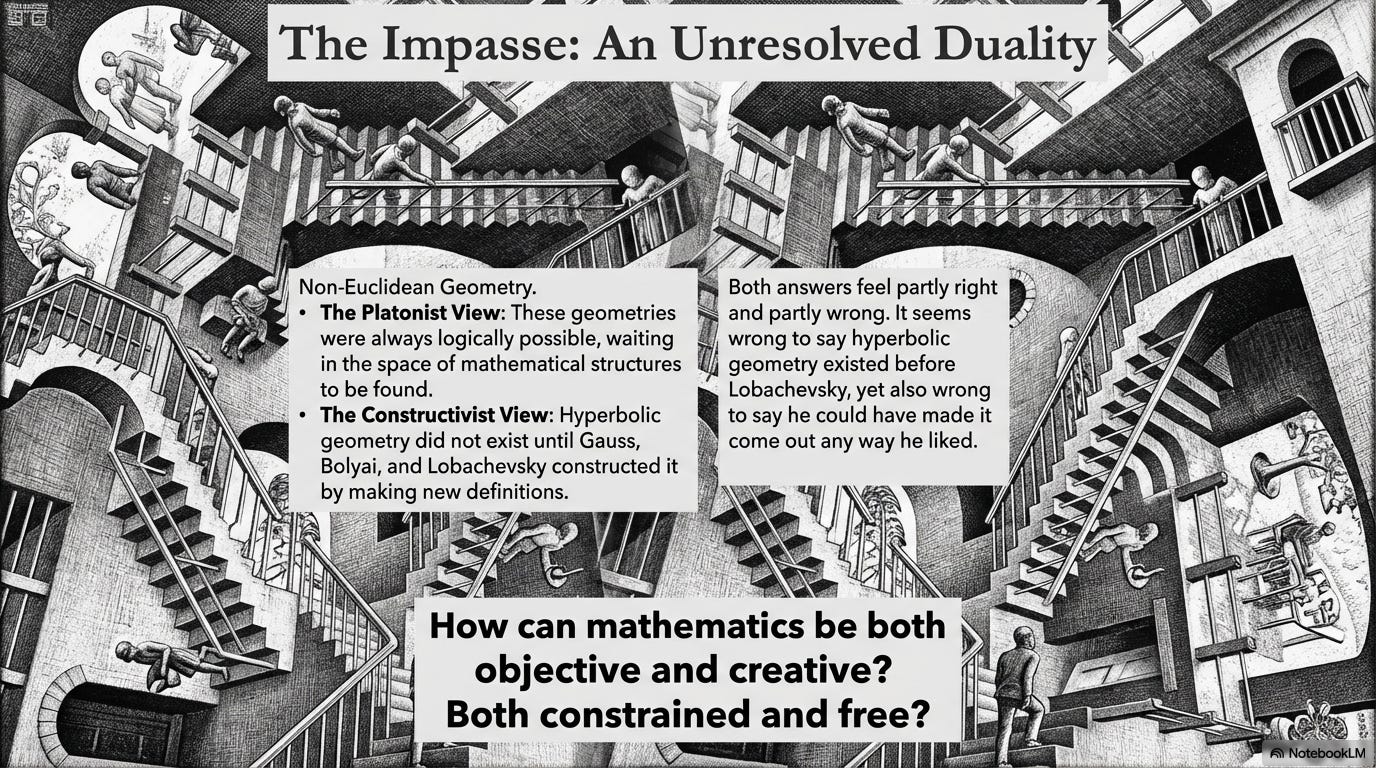
For two thousand years, mathematicians tried to prove Euclid’s fifth postulate (the parallel postulate) from the other axioms, sensing that it was somehow different. In the nineteenth century, Gauss, Bolyai, and Lobachevsky independently realized that consistent geometries could be constructed in which the parallel postulate was false. Was non-Euclidean geometry discovered or invented?
The Platonist says discovered: these geometries were always logically possible, always “there” in the space of mathematical structures, waiting for someone to find them. The constructivist says invented: there was no “hyperbolic geometry” until mathematicians constructed it; they made it real by defining it.
Both answers feel partly right and partly wrong. It seems wrong to say that hyperbolic geometry existed in the same way before and after Lobachevsky. Yet it also seems wrong to say that Lobachevsky simply made it up, as if he could have made it come out any way he liked. He was constrained by the requirement of consistency, by the logical relations among geometric concepts, by the structure of the enterprise he was engaged in.
What we see in the case of non-Euclidean geometry is a space of participation that remained underdetermined for two thousand years. The status of the parallel postulate was not settled; multiple resolutions were possible. Gauss, Bolyai, and Lobachevsky determined that the space of mathematical possibility was broader than previously established, revealing that consistent geometries could exist without the parallel postulate. This was neither pure discovery of a pre-existing fact nor arbitrary invention—it was a determination within a real coherence-structure that allowed for multiple coherent resolutions.
What is needed is a framework that can accommodate both the objectivity of mathematical constraint and the creativity of mathematical practice. This is what Participational Realism provides.
Participational Realism and Mathematical Determination
Participational Realism, my currently under development work, rests on three pillars:
Ontological realism about patterns: Relational structures and patterns are genuinely real, not reducible to located objects, and not merely useful descriptions.
Real normativity: Some patterns have genuine normative structure—they establish what counts as correct or incorrect participation.
Dynamic determination: In cases where a pattern is real but not fully specified, agents can determine what was previously undetermined through constrained participatory action.
Applied to mathematics, this framework suggests that mathematical activity is neither discovery (perceiving pre-existing completed structures) nor invention (arbitrary construction). It is determination: the bringing into determinacy of structures that were genuinely undetermined, through participation constrained by real coherence-structures.
The Coherence-Structure of Mathematics
Consider the mathematical landscape not as a completed Platonic realm—a finished mansion where every room already exists—but as a space of constraints and coherences, some actual, some potential, many undetermined. Certain relationships are determinate: once you have the integers and the operations of addition and multiplication, the prime numbers are fixed. Their distribution is constrained by the coherence-structure of arithmetic, even though many questions about that distribution (like the Riemann hypothesis) remain unresolved.
But other structures are not determinate until they are constructed. Before Hamilton’s work, was there a determinate fact about whether a four-dimensional analog of complex numbers existed? The Platonist would say yes—the quaternions existed eternally in the realm of abstract objects. The constructivist would say no—Hamilton invented them.
Participational Realism says: the constraint-structure was real. The requirements for a consistent algebraic structure extending the complex numbers were not arbitrary. Hamilton did not simply make up the quaternions by fiat. He participated in a real coherence-structure for years, seeking a form that would satisfy the constraints he discerned. But within those constraints, the specific form of the solution was undetermined until he determined it.
This understanding of mathematical activity as participation in real but underdetermined coherence-structures transforms our conception of the mathematician’s role. The mathematician is not a scribe copying from a pre-written “Platonic Book,” nor an author writing fiction unconstrained by reality. The mathematician is a participant co-authoring the book of mathematics—navigating objective constraints while exercising genuine creative agency to determine the specific structures that define those spaces.
Hamilton and the Architecture of Mathematical Determination
William Rowan Hamilton’s creation of the quaternions serves as a primary illustration of mathematical determination, providing a concrete “third way” between the traditional views of discovery and invention. This case demonstrates how a mathematician brings a structure into determinacy through participation constrained by real coherence-structures.
The Reality of Constraints
Participational Realism acknowledges the Platonist insight that mathematicians are not free to make things up by fiat. For years, Hamilton sought a three-dimensional analog to complex numbers, attempting to extend the success of representing two-dimensional quantities as a + bi to three dimensions. But he was repeatedly blocked. The equations would not close properly; the algebraic operations failed to satisfy the requirements of a consistent number system.
Hamilton was constrained by the requirement of consistency and by the logical relations inherent in algebraic extension. This “forcing quality”—where the subject matter resists certain paths—indicates that Hamilton was interacting with an objective coherence-structure rather than an arbitrary human convention. The mathematics itself pushed back against his attempts.
Resolving Underdetermination
While the constraints were real, they did not uniquely dictate a single pre-existing result. The space was underdetermined until Hamilton engaged with it through years of participatory struggle.
The breakthrough came through a creative leap: Hamilton realized he needed to sacrifice commutativity (the rule that a × b = b × a) and move to four dimensions instead of three. This was not an obvious move—indeed, commutativity had been a defining feature of all number systems known at the time. Hamilton’s willingness to abandon this assumption opened a space that did not exist before.
On October 16, 1843, while walking along the Royal Canal in Dublin with his wife, the solution came to him in a flash
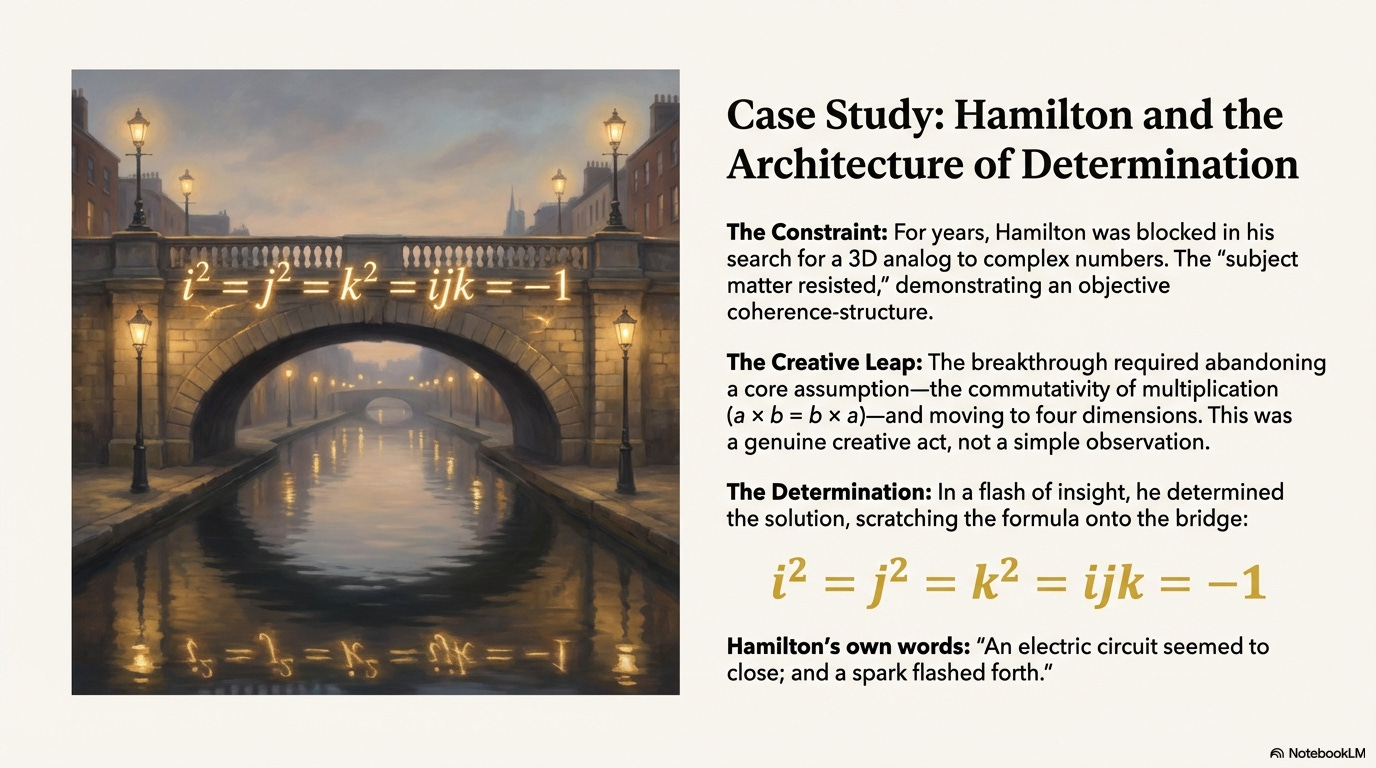
. He famously scratched the fundamental formula on Brougham Bridge:
i² = j² = k² = ijk = −1
Hamilton himself described this as a discovery:
“I felt at once the importance. An electric circuit seemed to close; and a spark flashed forth.”
Yet the “discovery” was enabled by a creative determination—abandoning the assumption of commutativity—that opened a space of possibility that was genuinely new.
Dissolving the Discovery/Invention Dichotomy
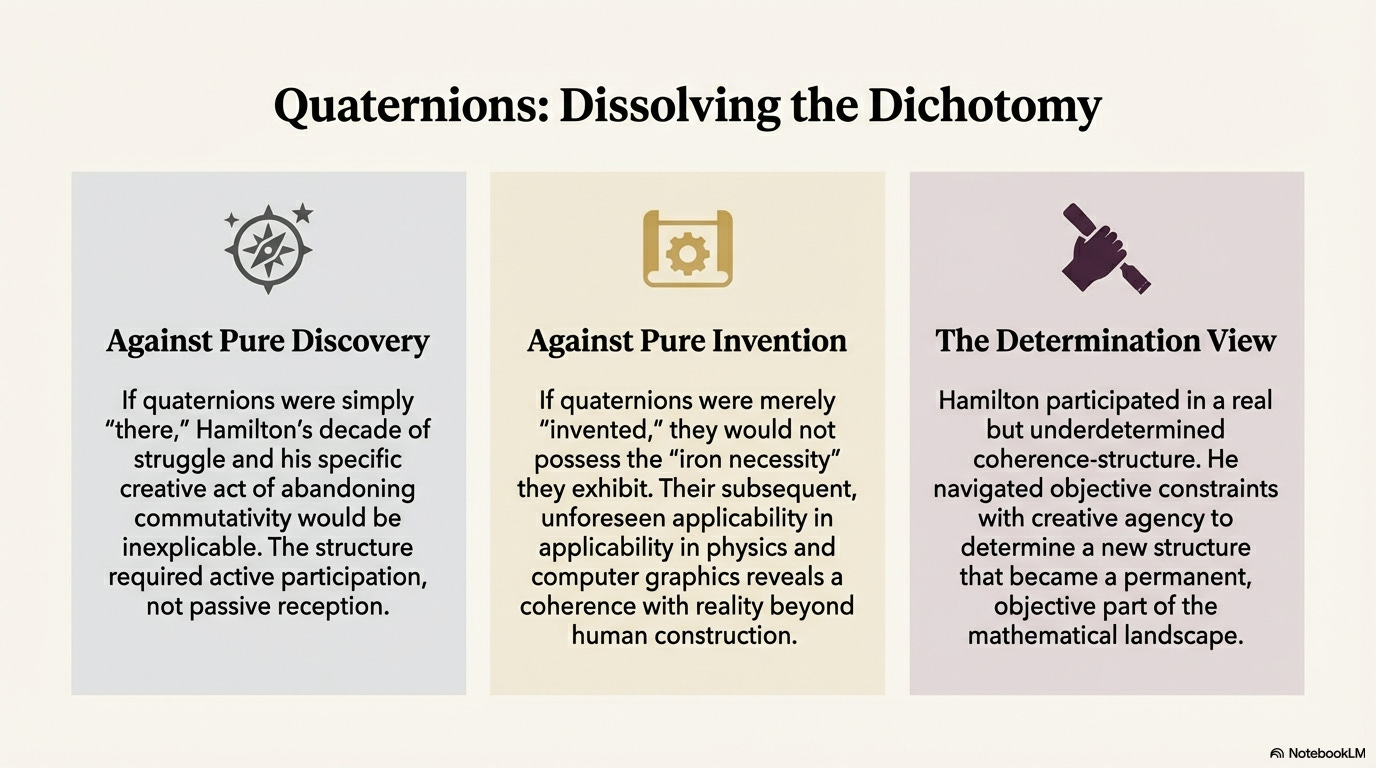
The quaternions illustrate why neither “discovery” nor “invention” fully captures the mathematical experience
:
Against Pure Discovery: If quaternions were simply “there” in a Platonic realm, Hamilton’s decade of struggle and his specific creative decision to abandon commutativity would be reduced to a mere “note of an observation,” as Hardy might put it. But the struggle was real, and the creative leap was essential. The structure did not reveal itself passively to a receptive mind; it required active determination through years of constrained participation.
Against Pure Invention: If Hamilton had merely “invented” the quaternions as a social convention or arbitrary construction, the structure would not have the “iron necessity” that it exhibits. Once determined, quaternions possess properties that Hamilton did not anticipate and could not have chosen otherwise. Moreover, their subsequent applicability to physics—quaternions are essential to the mathematics of three-dimensional rotations and appear in computer graphics, aerospace engineering, and quantum mechanics—was not guaranteed by the construction. This applicability was discovered empirically, revealing that the mathematical structure Hamilton determined coheres with the structure of physical reality in ways he could not have foreseen.
The Metaphor of the Unfinished Book
Hamilton was not a scribe copying from a pre-written “Platonic Book,” but rather a participant co-authoring the book of mathematics. By navigating the objective constraints of algebraic possibility, he determined a new structure that became a permanent part of the mathematical landscape. Once he determined this structure, its subsequent properties and theorems followed with the objectivity that Platonists like Gödel and Penrose describe. The quaternions, once determined, exhibit the same “forcing quality” as any mathematical truth—their properties are not up to us.
The broader implication is that Erdős’s “Book” may have been closer to the truth than he knew—but in a different sense than pure Platonism suggests. There is something objective that mathematicians are oriented toward: a coherence-structure that constrains and guides their work. But The Book is not already written, waiting to be read. It is being written through the participatory engagement of mathematicians, who determine its contents by navigating the constraints that define its possibility.
The Forcing Quality of Mathematical Truth
The framework of Participational Realism takes seriously what Gödel called the “forcing quality” of mathematical truth—the phenomenological experience where mathematical axioms and truths seem to impose themselves on the mind as objectively true, rather than being arbitrary human choices. This forcing quality is not merely a psychological curiosity; it is the key to understanding both the nature of mathematical knowledge and why mathematics is so effective at describing the physical universe.
Within a given coherence-structure, certain relationships are determined. Once you have accepted the axioms of arithmetic, you cannot make the primes come out differently than they do. The coherence-structure is real and constraining. This explains the experience that Gödel and Hardy described—the sense that mathematical truths “force themselves upon us.”
But Participational Realism also explains something that pure Platonism struggles with: the role of creative choice in mathematical development. The choice of which structures to investigate, which axioms to adopt, which questions to ask—these are genuine choices that shape mathematical development. They are not merely discovering which door to open in a pre-existing mansion; they are determining which structures become actual within the space of mathematical possibility.
This is why mathematics has a history. Pure Platonism, taken strictly, should imply that all mathematical truths are equally “there” for the finding, yet mathematical development clearly has a trajectory shaped by human choices, cultural contexts, and creative insights. Participational Realism explains this: the constraint-structure is real and mind-independent, but the specific path through that structure, and the particular determinations made along the way, are genuinely dependent on participatory action.
Case Study: The Complex Numbers
The history of complex numbers illustrates the Participational Realism perspective vividly, demonstrating how the forcing quality of mathematical truth eventually compels acceptance even of initially unwelcome structures.
In the sixteenth century, mathematicians encountered complex numbers as unwelcome guests. Solving cubic equations by Cardano’s formula sometimes required taking square roots of negative numbers, even when the final answers were real. Mathematicians performed the manipulations, but they did not accept these “imaginary” quantities as genuine numbers. Rafael Bombelli, who worked extensively with these manipulations, called them “a wild thought” and “useless.”
For centuries, complex numbers existed in a kind of mathematical limbo—used when necessary but not accepted as legitimate mathematical objects. They were treated as computational fictions rather than genuine numbers. Yet as mathematicians participated in the coherence-structure of algebraic extension, the internal logic of mathematics increasingly “forced” these numbers toward acceptance because of their undeniable coherence and utility.
Over time, complex numbers gained acceptance as their power became undeniable. Euler worked with them systematically, deriving the astounding identity e^(iπ) + 1 = 0, which connects the fundamental constants of arithmetic, analysis, and geometry in a single equation of breathtaking elegance. Gauss and Argand provided geometric interpretations: complex numbers as points or vectors in a two-dimensional plane. Cauchy and Riemann developed complex analysis, revealing that these “imaginary” numbers obeyed deep and beautiful laws.
By the twentieth century, complex numbers were indispensable not just in pure mathematics but in physics—quantum mechanics is formulated in the language of complex numbers, and they are essential to electrical engineering and signal processing.
Now, the question: were complex numbers discovered or invented?
The pure Platonist says discovered. Complex numbers were always “there” in the mathematical realm; mathematicians gradually perceived them more clearly.
But this does not account for the historical struggle. If complex numbers were simply there to be perceived, why did perception take centuries? Why did it require creative reconceptualizations (the geometric interpretation, the development of complex analysis) to make the perception possible?
The pure constructivist says invented. Mathematicians created complex numbers by extending the real numbers with a new symbol, i, and defining rules for its manipulation.
But this does not account for the coherence. Mathematicians could not make complex numbers behave however they liked. Once the extension was defined, the theorems followed with iron necessity. And—crucially—the applicability to physics was not guaranteed by the construction; it was discovered empirically. The physical world obeys the same necessity found in the mathematical structure, a fact that construction alone cannot explain.
Participational Realism says: the coherence-structure of algebraic extension was real. Given the real numbers and the project of extending them to include solutions to all polynomial equations, constraints were in place. But those constraints did not uniquely determine one outcome. Mathematicians, through centuries of participatory engagement, determined the complex numbers as a specific resolution of those constraints—a resolution that cohered with the constraint-structure and opened new domains of coherence (complex analysis, the geometric interpretation, the applications to physics).
The complex numbers were not waiting, fully formed, in a Platonic heaven. Nor were they arbitrary inventions that could have come out any way we liked. They were determined through constrained participation in a real coherence-structure. And the fact that this mathematically determined structure turned out to be indispensable for quantum mechanics reveals something profound: the same coherence-structures that constrain mathematical possibility also constrain physical reality.
Case Study: The Axiom of Choice
A more controversial example sharpens the point and illustrates how mathematicians navigate genuinely underdetermined structures. The Axiom of Choice (AC) states that given any collection of non-empty sets, it is possible to select one element from each set. This seems obvious for finite collections but becomes problematic for infinite ones, where no explicit selection rule may exist.
Ernst Zermelo formulated the axiom in 1904, recognizing that it was implicitly used in many proofs. The mathematical community was divided. Some results that followed from AC seemed counterintuitive or even paradoxical—notably the Banach-Tarski paradox, which shows that a solid sphere can be decomposed into finitely many pieces and reassembled into two spheres of the same size.
Today, most mathematicians accept AC, but alternative set theories that reject or weaken it are also studied. Gödel proved that if the standard axioms of set theory (ZF) are consistent, then so is ZF + AC. Cohen proved that if ZF is consistent, then so is ZF + not-AC. The axiom is independent: the constraints of set theory do not determine whether it holds.
What is the status of the Axiom of Choice?
The Platonist must say that there is a determinate truth about whether AC holds in the realm of sets. We may not know it, but it is either true or false.
The constructivist may say that AC is a choice we make in setting up our formal system—neither true nor false in itself, but adopted or rejected as a convention.
Participational Realism offers a third view. The coherence-structure of set theory is real but underdetermines whether AC holds. Within that structure, AC and its negation are both coherent. Mathematicians, through participatory engagement, have determined that AC is part of standard mathematical practice—not because they discovered a pre-existing fact, but because they found that working with AC leads to a more powerful and coherent mathematical practice. This determination is not arbitrary; it is constrained by considerations of coherence, fruitfulness, and mathematical power. But it is also not discovery of a pre-existing fact; it is a genuine determination of what was undetermined.
This explains why mathematicians can also productively study systems without AC. The constraint-structure allows for multiple coherent resolutions, and mathematicians can determine different resolutions in different contexts. The disagreements that exist over foundational questions—whether to accept large cardinal axioms, whether certain proof methods are legitimate, whether certain objects are “real”—are not merely conventional (which would make them arbitrary) nor about pre-existing facts (which would make them decidable in principle). They are disagreements about how to navigate and determine a coherence-structure that allows for multiple paths.
Current debates in mathematics, such as those over large cardinal axioms or the foundations of set theory, can be understood as instances where mathematicians are participating in an underdetermined structure and disagreeing on how it should be resolved. These are not disagreements about what is already written in The Book; they are disagreements about what should be written.
The Unreasonable Effectiveness Reconsidered
Wigner’s puzzle about the unreasonable effectiveness of mathematics becomes more tractable on the Participational Realism view. If mathematics is pure invention, its applicability to physics is a miracle—why should our arbitrary constructions match the world? If mathematics is discovery of a separate Platonic realm, we face two mysteries: how we access that realm, and why it should match the physical world.
Participational Realism uses the “forcing quality” of mathematical truth to argue that this effectiveness is not a miracle but a result of shared coherence-structures. The same real constraints that “force” a mathematician to accept certain truths (like the distribution of prime numbers) also constrain the physical possibilities of the universe. When mathematicians determine structures that prove applicable to physics, they are not discovering pre-existing forms or inventing arbitrary ones; they are determining patterns within a coherence-structure that also constrains physical possibilities.
The case of complex numbers and quantum mechanics is illuminating here. For centuries, mathematicians treated the square root of negative numbers as “imaginary” or “useless.” However, as they participated in the coherence-structure of algebraic extension, the internal logic of mathematics forced these numbers into acceptance because of their undeniable coherence and utility. By the twentieth century, these “imaginary” structures became the indispensable language of quantum mechanics.
The applicability of complex numbers to physics was not guaranteed by the mathematical construction—it was an empirical discovery that the physical world obeys the same iron necessity found in the mathematical structure. This suggests that the human mind and physical reality are not two separate realms randomly aligned by miracle or coincidence. Instead, through the forcing nature of mathematical truth, the mind is able to access and determine the very structures that govern the natural world.
Roger Penrose argues that because mathematical truth has an “absolute nature” independent of human convention, it must have profound implications for our understanding of the laws of the universe. Participational Realism agrees that once a structure is determined within a coherence-space, its consequences follow objectively. In physics, this means that once certain physical constants or relational structures are actualized in the universe, the resulting laws of physics are not arbitrary; they are constrained by the underlying coherence of the system.
This also helps resolve the Benacerraf problem—the puzzle of how humans can have knowledge of “causally inert” abstract objects. On the Participational Realism view, we do not observe abstract objects across a causal gap, as if we were perceiving things in a separate realm. Rather, we participate in the same coherence-structures that define mathematical truth. Mathematical knowledge is not perception of distant objects but attunement to coherence-structures through constrained participatory action. The gap between mind and abstract reality closes because both are embedded in the same web of coherence.
Implications and Resonances
For Mathematical Practice
Participational Realism aligns with how many mathematicians describe their experience. The interplay of constraint and creativity, the sense that some things are discovered while others are created, the experience of being both bound by the subject and free to explore it—these phenomenological reports are better accommodated by determination than by either pure discovery or pure invention.
The framework also illuminates mathematical disagreement. When mathematicians disagree about foundational questions—whether to accept large cardinal axioms, whether certain proof methods are legitimate, whether certain objects are “real”—they are often disagreeing about which determinations to make within an underdetermined constraint-structure. Such disagreements are not merely conventional (which would make them arbitrary) nor about pre-existing facts (which would make them decidable in principle). There are disagreements about how to navigate and determine a coherence-structure that allows for multiple paths.
For Mathematical Education
If mathematics is determination rather than discovery or invention, then mathematical education should involve both initiation into constraint-structures and practice in making determinations. Students need to learn the constraints—the definitions, axioms, and techniques that structure mathematical practice. But they also need opportunities to navigate underdetermined problems, to make choices, and to experience the interplay of freedom and constraint that characterizes mathematical thinking.
This suggests a pedagogy that goes beyond rote learning of established results and beyond unguided “discovery learning.” Students should experience the forcing quality of mathematical truth—the way that certain results impose themselves once the constraints are in place—while also experiencing the genuine openness of mathematical exploration, where multiple paths are possible and creative choices matter.
For the Nature of Truth
Participational Realism suggests a view of mathematical truth that is neither correspondence (truth as matching a pre-existing reality) nor coherence (truth as internal consistency) nor pragmatism (truth as what works) but something that incorporates elements of all three. Mathematical statements are true when they cohere with a real constraint-structure; this coherence is objective (not arbitrary), but the determination of specific structures involves participatory action and may be underdetermined by the constraints alone.
This view resonates with Imre Lakatos’s quasi-empiricism about mathematics, developed in Proofs and Refutations (1976). Lakatos argued that mathematical knowledge develops through a dialectical process of conjecture, proof, and refutation—not unlike empirical science. Participational Realism provides a metaphysical framework for this insight: the dialectic is one of progressively determining structures within a space of constraints, through participatory engagement that is neither passive reception nor arbitrary construction.
For the Unity of Knowledge
Perhaps most profoundly, Participational Realism suggests a deep unity between mathematical and physical reality. The laws of physics are not mere human descriptions but objective determinations within a real, mind-independent space of constraints that mathematicians and physicists both explore. The forcing quality of mathematical truth and the lawfulness of physical reality are not separate phenomena requiring separate explanations; they are manifestations of the same underlying coherence-structures.
This does not collapse mathematics into physics or physics into mathematics. Each domain has its own methods and objects. But it does suggest that the “unreasonable effectiveness” of mathematics in physics is not unreasonable at all—it is the natural result of both domains being participatory engagements with the same fundamental coherence of reality.
Conclusion: The Path Not Taken
The debate between Platonism and anti-Platonism has structured philosophy of mathematics for generations. Both sides have powerful intuitions and formidable arguments. But the debate may rest on a false dichotomy.
Participational Realism offers a third way. Mathematical objects and truths are not waiting, complete and determinate, in a Platonic realm; nor are they arbitrary human creations. They are determinations—specific resolutions of real coherence-structures, achieved through constrained participatory engagement.
This view preserves what is compelling in Platonism: the objectivity of mathematical truth, the reality of mathematical constraint, the forcing quality that Gödel described, and the independence of mathematical structures from individual whim. But it also preserves what is compelling in anti-Platonism: the role of human creativity in mathematical development, the significance of historical and cultural context, and the avoidance of mysterious metaphysical commitments about causally inert objects in a separate realm.
The history of mathematics, in this view, is a history of determination: the progressive determination of structures within a coherence-space that allows for genuine creativity within real constraint. Mathematicians are neither scribes copying from a Platonic Book nor authors writing fiction. They are participants in a coherence-structure, navigating its constraints, and determining, through that navigation, structures that become part of the mathematical landscape.
Hamilton, struggling for years to extend the complex numbers, was not merely failing to perceive what was already there. He was participating in a real but underdetermined coherence-structure, and his creative leap—sacrificing commutativity, moving to four dimensions—was a genuine act of determination that brought the quaternions into being. Once determined, they exhibited the objective properties that Platonists rightly emphasize. But their determination required human participation in a way that pure Platonism cannot capture.
The same pattern appears throughout mathematical history: the centuries-long struggle over complex numbers, the independent determination of non-Euclidean geometry, the ongoing debates over the Axiom of Choice and large cardinal axioms. In each case, we see neither pure discovery nor pure invention but constrained participation in coherence-structures that are real enough to resist arbitrary manipulation yet open enough to allow genuine creative determination.
Paul Erdős may have been closer to the truth than he knew when he spoke of “The Book.” There is something objective that mathematicians are oriented toward—a coherence-structure that constrains and guides their work. But The Book is not already written, waiting to be read.
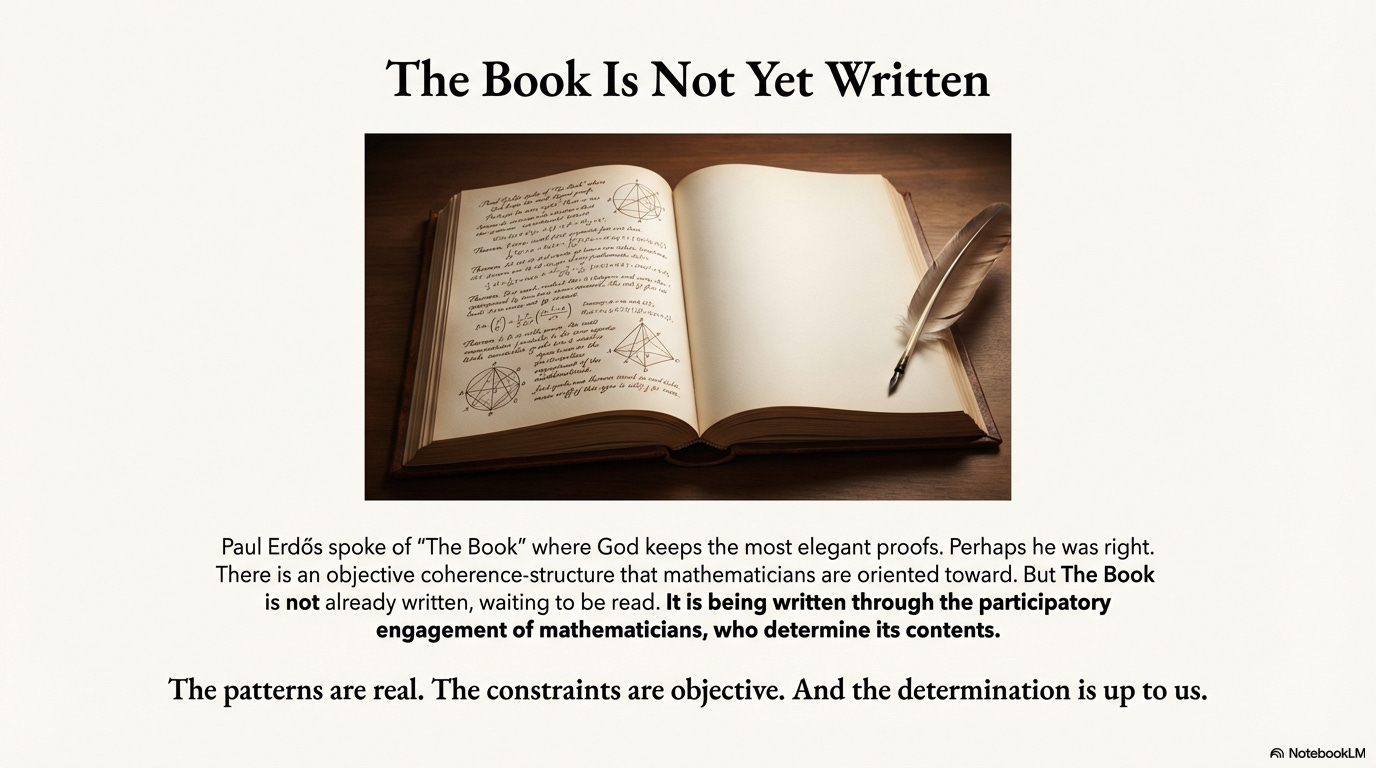
It is being written through the participatory engagement of mathematicians, who determine its contents by navigating the constraints that define its possibility.
The question “Is mathematics discovered or invented?” may admit neither answer. Mathematics is determined—and in that determination, the distinction between discovery and invention dissolves into something richer and more adequate to the phenomenon: the ongoing participatory determination of structures within a real but inexhaustible coherence-space.
The patterns are real. The constraints are objective. And the determination is up to us.
References
Benacerraf, Paul. “Mathematical Truth.” The Journal of Philosophy 70, no. 19 (1973): 661–679.
Gödel, Kurt. “What Is Cantor’s Continuum Problem?” American Mathematical Monthly 54, no. 9 (1947): 515–525. Reprinted and revised in Philosophy of Mathematics: Selected Readings, edited by Paul Benacerraf and Hilary Putnam. Cambridge University Press, 1983.
Hardy, G.H. A Mathematician’s Apology. Cambridge University Press, 1940.
Hersh, Reuben. What Is Mathematics, Really? Oxford University Press, 1997.
Lakatos, Imre. Proofs and Refutations: The Logic of Mathematical Discovery. Cambridge University Press, 1976.
Penrose, Roger. The Road to Reality: A Complete Guide to the Laws of the Universe. Jonathan Cape, 2004.
Wigner, Eugene. “The Unreasonable Effectiveness of Mathematics in the Natural Sciences.” Communications in Pure and Applied Mathematics 13, no. 1 (1960): 1–14.