
Orientational Realism: An Introduction
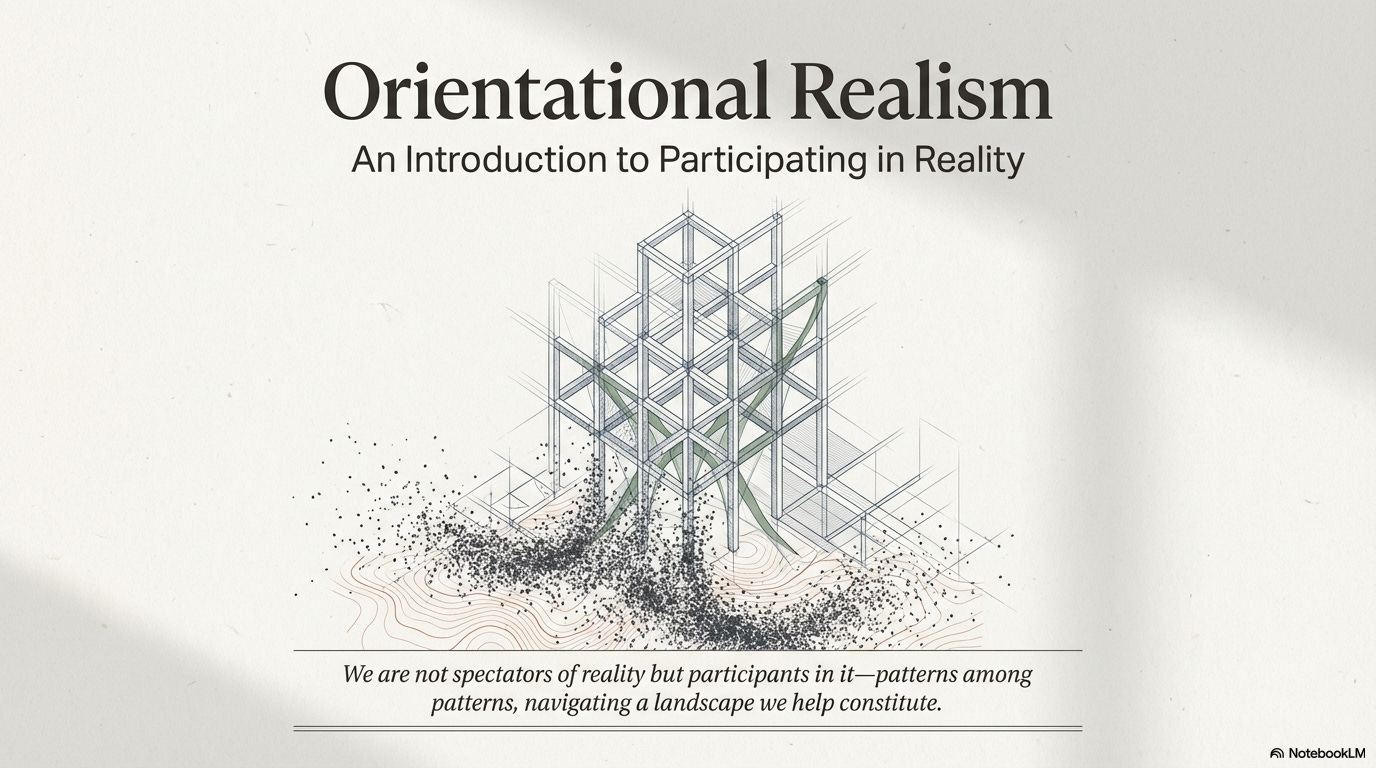
We are not spectators of reality but participants in it - patterns among patterns, navigating a landscape we help constitute

“We are not spectators of reality but participants in it—patterns among patterns, navigating a landscape we help constitute.”
Note: In the previous post, I applied Orientational Realism to the mathematical domain to propose a "third way" that transcends the discovery-versus-invention debate. However, I bypassed a formal introduction to the framework itself—an omission I aim to correct here. While the concepts of patterns, participation, agency, embodiment, coherence and "cognitive glue" draw from a vast intellectual lineage, I must specifically acknowledge the foundational influence of Michael Levin, Francisco Varela, Buddhist and Daoist world outlooks.
Introduction: A Different Starting Point
For centuries, philosophy has asked: What is the world made of? Atoms? Fields? Mind? Matter? Some neutral substance underlying both?
Orientational Realism (OR) suggests this is the wrong question. It reframes our entire understanding by asking not what things are, but what patterns they form, and how we navigate the guidance those patterns provide.
The central insight of OR can be stated simply: reality is fundamentally orientational—structured not merely by static forms but by directions, gradients, and attractors that guide those who learn to perceive them. The world is not a collection of inert objects waiting to be observed. It is a landscape with slopes and contours, inviting navigation.
This is not merely an academic theory. It is an invitation to see the world differently—and to understand your place within it not as an observer looking in from outside, but as a participant navigating from within.
Part One: From Things to Patterns
The Primacy of Pattern
Consider a melody. Where is it? Not in any single note—each note passes and the melody persists. Not in the air vibrations—the same melody can be hummed, played on piano, rendered by an orchestra. Not in your brain—others hear the same melody. The melody exists, clearly. It affects us. It can be recognized, remembered, performed well or badly. But it is not a thing in the ordinary sense.
The melody is a pattern: a structure of relations that persists across different instantiations, constrains what counts as continuing it, and has genuine effects in the world.
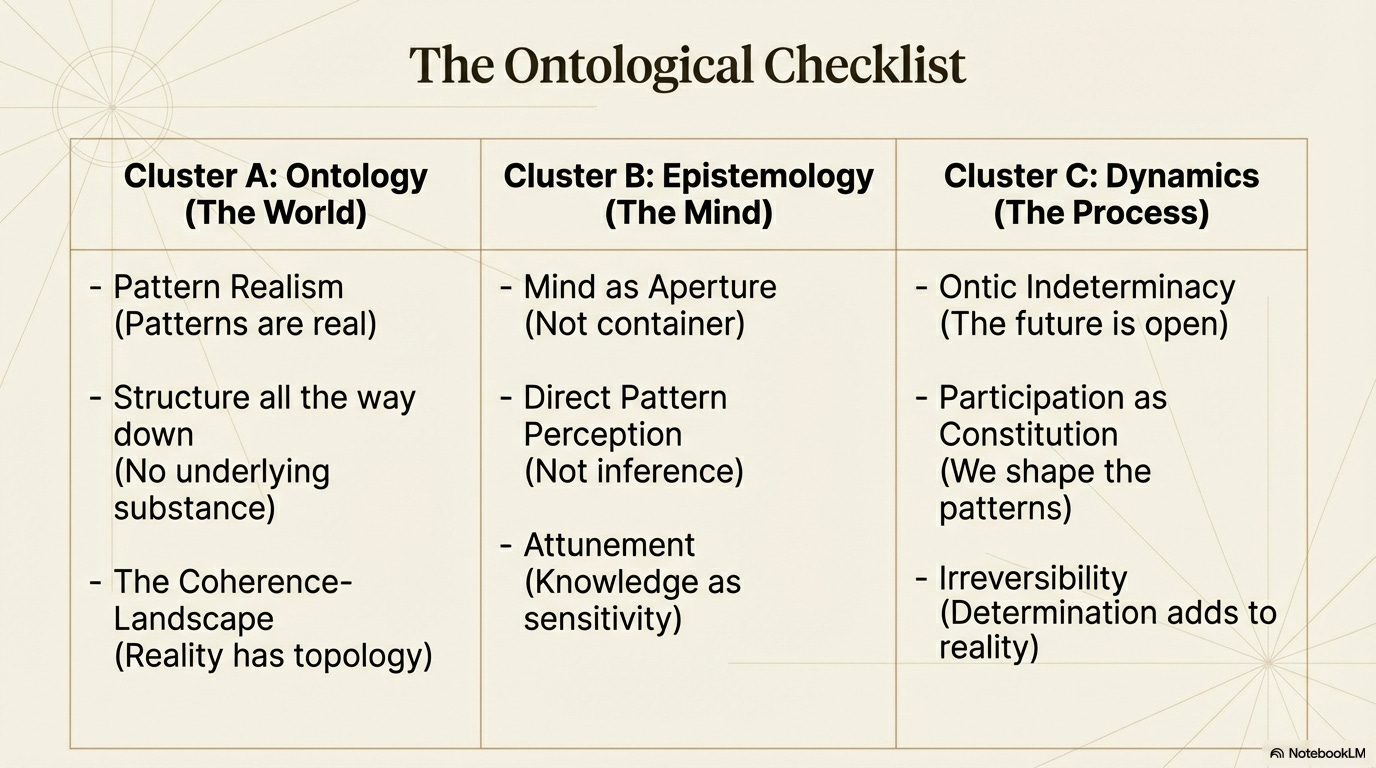
Orientational Realism begins here: patterns are real. They are not merely useful descriptions we impose on an underlying chaos, nor convenient fictions, nor subjective experiences. They are genuine features of reality with their own ontological standing.
This is more radical than it first appears. Traditional philosophy often assumes that reality is made of substances—atoms, or fields, or minds—and that patterns are merely arrangements of these more fundamental things. OR reverses this: the pattern is not a property of the thing; the thing is the pattern, stably maintained.
An electron is a stable pattern in quantum fields. A person is a stable pattern of biological and psychological organization. A friendship is a stable pattern of mutual care and responsiveness. What we call “things” are patterns that have achieved sufficient stability to persist and be recognized.
What Makes a Pattern Real?
In OR, a pattern qualifies as real when it exhibits four features.
First, persistence: it maintains its structure through time, even as components change. You remain you as your cells are replaced.
Second, multiple realizability: it can be instantiated in different materials or media. A song can be sung, played, or whistled.
Third, causal relevance: it makes a difference to what happens. A bridge’s pattern determines whether it holds weight.
Fourth, constraint: it limits what is possible within it. A language enables certain expressions and forbids others.
Consider the pattern of a spiral staircase. It can be built from wood, stone, metal, or glass. The material changes; the pattern persists. The pattern constrains how you can ascend—you must turn as you climb. The pattern causes certain experiences—the gradual rotation, the limited sightlines. The pattern is real: not as a thing, but as a structure that persists, constrains, and has effects.
Structure All the Way Down
OR makes a strong claim: there is no substrate beneath patterns. Patterns are not patterns of some more fundamental stuff.
This challenges the intuition that patterns must be patterns of something—that beneath the arrangement there must be things being arranged. But consider: what would that underlying stuff be? If you describe it, you describe its structure—its patterns. If it has no describable structure, it does no explanatory work.
The melody is not a pattern of sound—sound is itself a pattern of pressure waves, which are patterns of molecular motion, which are patterns of quantum fields. At no level do we find patternless stuff that patterns are made of. It’s patterns all the way down.
This view is sometimes called structural realism. OR accepts this but extends it in a crucial direction: structure is not merely static form. It is oriented.
Part Two: Orientation and the Coherence-Landscape
Why “Orientational”?
The framework is called Orientational Realism because its distinctive claim is that reality is not just structured but directionally structured. Patterns have gradients—directions of better and worse, more and less coherent. The fundamental relation between a knower and the known is not passive observation but active orientation: being aimed at something, guided by something, responsive to direction.
Think of the difference between a photograph of a mountain and actually standing on its slopes. The photograph shows structure. But standing on the mountain, you feel the slope beneath your feet. You sense which way is uphill, which path leads toward the summit, which route is passable. The mountain orients you.
OR claims that reality as a whole has this character. It is not a flat collection of facts but a terrain with topology—and we navigate it by feeling the gradients.
The Coherence-Landscape
The coherence-landscape is the central concept of Orientational Realism. It is the “topography” of any domain—the structure of how patterns fit together, support each other, or conflict.
But first: what is coherence?
Coherence is the relation of fit, consistency, and mutual support among patterns. A coherent configuration is one where parts work together, support each other, and form a stable whole. Incoherence is tension, conflict, instability—parts that don’t fit, that work against each other, that tend to fall apart.
The coherence-landscape is the topology of these relations. Some configurations are highly coherent—like valleys, stable, where things tend to settle. Others are incoherent—like peaks, unstable, where things fall away. Between them are slopes—gradients pointing toward greater or lesser coherence.
Gradients and Attractors
A gradient is the direction toward greater or lesser coherence at any point in the landscape. Just as a physical gradient tells you which way is downhill, a coherence gradient tells you which direction leads toward better fit, more stability, deeper resolution.
An attractor is a region of high coherence that draws movement toward it—a stable configuration where things tend to settle.
This structure appears across every domain of human experience.
In music, a melody creates tension that “wants” to resolve. The tonic chord is an attractor; dissonance creates a gradient toward it. The wrong note is perceivably wrong—it violates the coherence-structure.
In mathematics, some proof strategies feel promising; others feel like dead ends. Elegance is the perception of coherence. The mathematician senses the gradient toward a solution before finding it.
In ethics, some actions fit with human flourishing; others violate it. The wise person perceives what the situation calls for—the gradient toward coherent response.
In conversation, some responses fit the dialogue; others derail it. We feel when a conversation is “going somewhere” versus falling apart.
In science, some theories explain and predict; others fail to cohere with evidence. Good theories are attractors—evidence converges on them.
The crucial insight: we can perceive these gradients. This is what it feels like to sense that a solution is close, that a melody wants to resolve, that an argument is on the right track. Gradient perception is the fundamental mode of engagement with the coherence-landscape.
The Wrong Note Is Really Wrong
Consider a musician playing a wrong note. The wrongness is not merely a matter of convention or preference. Given the harmonic structure of the piece—its patterns of tension and resolution—certain notes genuinely do not fit. They violate the coherence-structure.
This is OR’s claim about normative structure: some patterns are not merely descriptive but normatively structured. They support better and worse ways of engaging with them. The normativity is in the pattern, not projected onto it by the listener.
This extends beyond music. A proof can be valid or invalid, elegant or clumsy. An action can cohere with flourishing or undermine it. An interpretation can honor a text or distort it. A response can fit a situation or miss it entirely.
In each case, the pattern itself has coherence-structure that can be honored or violated. We perceive this structure as normative guidance—the felt sense of what fits and what doesn’t.
Part Three: The Participant
Pattern Among Patterns
Now we arrive at a crucial insight that distinguishes OR from traditional philosophy: the participant is not outside the coherence-landscape, observing it from a privileged external position. The participant is itself a pattern—a self-maintaining, oriented, responsive pattern within the landscape.
You are not a mind looking at patterns from the outside. You are a pattern among patterns, navigating from within.
Your body is a biological pattern. Your mind is a psychological pattern. Your relationships are social patterns. Your habits, skills, and character are patterns of engagement. All of these are real structures that persist, constrain, and guide—and all of them are you.
This dissolves the traditional subject/object dichotomy that has haunted Western philosophy. We are not subjects confronting a world of objects. We are participants in a coherence-landscape that includes us—patterns engaging with patterns, structure responding to structure.
What Makes a Participant?
Not every pattern is a participant. A circle is a pattern, but it doesn’t participate in anything. A rock is a stable pattern, but it doesn’t navigate coherence-landscapes.
What distinguishes a participant? OR identifies four capacities.
Self-maintenance means the pattern actively maintains itself through ongoing processes, rather than merely persisting passively.
Orientation means the pattern is directed toward something beyond itself—it is aimed, intentional in the phenomenological sense.
Responsiveness means the pattern adjusts based on feedback from what it engages with, rather than merely reacting causally.
Sensitivity to gradient means the pattern can perceive directions toward greater or lesser coherence—it can feel the slopes of the landscape.
A thermostat has responsiveness but not orientation toward meaning. A rock has stability but not self-maintenance through active processes. A living organism has all four: it maintains itself, is oriented toward survival and flourishing, responds to its environment, and is sensitive to gradients of temperature, nutrients, and threats.
Humans have these capacities in developed form—especially sensitivity to coherence-gradients across many domains: practical, theoretical, ethical, aesthetic, social.
The Aperture Model of Mind
Traditional philosophy imagines the mind as a container—a vessel filled with representations of the external world. Locke’s “blank slate,” the computational metaphor of information storage, everyday talk of “having” ideas—all reflect this picture. The mind is inside; the world is outside; perception is getting representations of the outside into the inside.
This creates notorious problems. If all you have access to is the inside of the container, how do you know your representations match reality? This is the mind-body problem in its classic form.
OR proposes an alternative: the aperture model. Rather than a container that stores things, mind is better understood as an opening that participates in patterns.
An aperture doesn’t contain light; it opens onto light, allowing it to pass through, shaping what comes through by its characteristics. A camera aperture doesn’t store the scene; it allows the scene to affect the film. Similarly, mind doesn’t contain representations of reality; it opens onto reality, participating in patterns, shaped by and shaping what it engages with.
This reframing has consequences.
Perception is not capture and storage of external objects as internal representations. It is participatory engagement with patterns that are neither purely “in the world” nor purely “in the mind” but enacted through the relation between participant and environment.
Learning is not acquisition and storage of information. It is the attunement of the aperture—an increasing sensitivity to real structures and their gradients. The apprentice carpenter doesn’t merely accumulate facts about wood; she develops a feel for grain, an intuition for stress, an embodied understanding that cannot be fully articulated.
Understanding is not having a copy of the world inside your head. It is being able to navigate—knowing how to move through the coherence-landscape of a domain, sensing gradients, finding paths.
Part Four: Selfing
The Self as Process
If the participant is a pattern, what is the self?
Traditional answers treat the self as a thing—a soul, a brain, an ego, a bundle of properties. OR proposes instead that the self is better understood as a process: a direction of “selfing” rather than a static entity.
Consider a whirlpool. Is it a thing? It has no permanent substance—water flows through it constantly. Yet it persists, it has a characteristic form, it affects its surroundings. The whirlpool is not a thing but a pattern of whirlpooling—a dynamic process that maintains itself through continuous activity.
The self is like this. There is no fixed entity called “you” that persists unchanged through time. There is a dynamic process of self-organization, self-maintenance, and self-direction—a pattern of “selfing” that maintains coherence through ongoing activity.
Implications of the Selfing View
This understanding has profound implications.
Personal identity is not about a persistent substance but about continuity of pattern. You remain you as your cells are replaced, your beliefs change, your relationships evolve—because the pattern of selfing maintains coherence, not because some unchanging core persists.
Psychological health is coherent selfing—the pattern maintaining itself well, responding to challenges, growing and adapting while preserving integrity. Mental illness might be understood as incoherence in the selfing process: fragmentation, rigidity, failure to maintain the pattern.
Authenticity is fidelity to one’s own pattern of selfing—not to some hidden “true self” waiting to be discovered, but to the coherence-structure of one’s own ongoing process.
Mortality is the cessation of the selfing process. The pattern no longer maintains itself. What persists—in memory, in effects, in influence on others—are the traces the pattern left in the larger landscape.
The Direction of Selfing
The “direction of selfing” refers to the characteristic way an individual opens onto the world—their particular orientation, their distinctive style of engagement, their unique aperture.
Every person opens onto the coherence-landscape from a particular position, with particular sensitivities, particular concerns, particular history. This is not merely subjective bias but perspective—a genuine position from which real structure is perceived.
Different directions of selfing are not automatically valid or equal. Some are more coherent than others. Some are more attuned to the landscape. Some are distorted by trauma, ideology, or pathology. But each is a real direction of engagement, a particular way of being oriented within the landscape.
Part Five: Embodiment
The Body as Medium of Participation
Participation in the coherence-landscape is not performed by a disembodied mind. It is enacted through the body. This is OR’s commitment to embodiment.
The body is not an obstacle to knowledge or a prison for the soul. It is the medium through which patterns are engaged, gradients perceived, and coherent action achieved.
Consider skilled perception. The wine taster perceives gradients of flavor through their trained palate. The physician perceives gradients of health through eyes, hands, and trained attention. The musician perceives gradients of coherence through ears attuned by years of practice. The craftsperson perceives gradients of quality through touch developed over decades.
In each case, the body is not a barrier but an instrument—the means by which the coherence-landscape becomes accessible.
Transparency in Skilled Engagement
When a skill is mastered, something interesting happens: the body becomes transparent.
The novice typist attends to fingers, keys, mechanics. The expert typist attends to meaning—the text emerging, the ideas forming. The fingers have become transparent: they serve the engagement without being noticed.
The novice driver attends to pedals, wheel, mirrors. The expert driver attends to the road, the traffic, the destination. The car has become an extension of the body, transparent in use.
This transparency is a mark of deep participation. The body (and its extensions in tools) becomes invisible as a means, serving the engagement with the pattern. Participant and pattern approach unity; the boundary becomes porous.
Embodied Gradient Perception
The gradients of the coherence-landscape are perceived through the body, not by a mind observing the body from above.
The mathematician doesn’t first calculate and then feel confidence; the felt sense of promising-direction is the perception itself, enacted bodily.
The ethical person doesn’t first reason and then feel that an action is wrong; the perception of wrongness is immediate, embodied, prior to articulation.
The artist doesn’t first analyze and then feel that a color is right; the rightness is perceived in the act of seeing, bodily engaged with the work.
This is why attunement cannot be fully transferred through propositions. You cannot tell someone how to perceive a gradient; they must develop the perceptual capacity through engaged practice. Knowledge of the coherence-landscape is embodied knowledge—skill, not just information.
Part Six: Participation
What Is Participation?
If reality is a structured landscape, how do we move through it? Through participation—oriented, responsive engagement with patterns.
Participation is more than being located within a pattern. A rock is located in a gravitational field, but it doesn’t participate in it—it merely undergoes gravitational effects. A bird flying through air participates: it perceives, adjusts, aims, responds to feedback, navigates toward destinations.
Participation has four key features.
Orientation means being directed toward the pattern, aimed at engaging it.
Responsiveness means adjusting based on feedback from the pattern.
Normativity means participation can be done better or worse, more or less faithfully.
Constitution means sometimes participation partly determines what the pattern becomes.
Degrees of Participation
Participation is not all-or-nothing. It comes in degrees, from shallow to deep to full.
Consider learning to play piano. The beginner reads notes haltingly, makes many errors, and has no sense of the whole—this is shallow participation. The intermediate player performs correctly but mechanically, following rules without feeling—this is moderate participation. The advanced player performs with expression and sensitivity to the music’s logic—this is deep participation. The master plays as though the music flows through them, player and piece becoming one—this is full participation.
The same progression occurs in any domain: the novice scientist, the apprentice craftsperson, the beginning meditator. Deeper participation means greater sensitivity, more nuanced response, closer attunement to the pattern’s coherence-structure.
Flow and Absorbed Participation
In the deepest participation, the boundary between participant and pattern becomes porous. This is what psychologists call flow: complete absorption in an activity, loss of self-consciousness, action and awareness merging.
The jazz musician in flow doesn’t think about the next note; the music thinks through them. The rock climber in flow doesn’t calculate handholds; the rock and body engage in seamless dialogue. The writer in flow doesn’t choose words; the words emerge from the engagement with meaning.
OR gives this phenomenology an ontological interpretation: in flow, participant and pattern achieve maximal integration. The participant becomes most fully transparent to the pattern’s coherence-structure. This is not loss of self but fullest expression of self—the selfing process at its most coherent.
Attunement: Developed Sensitivity
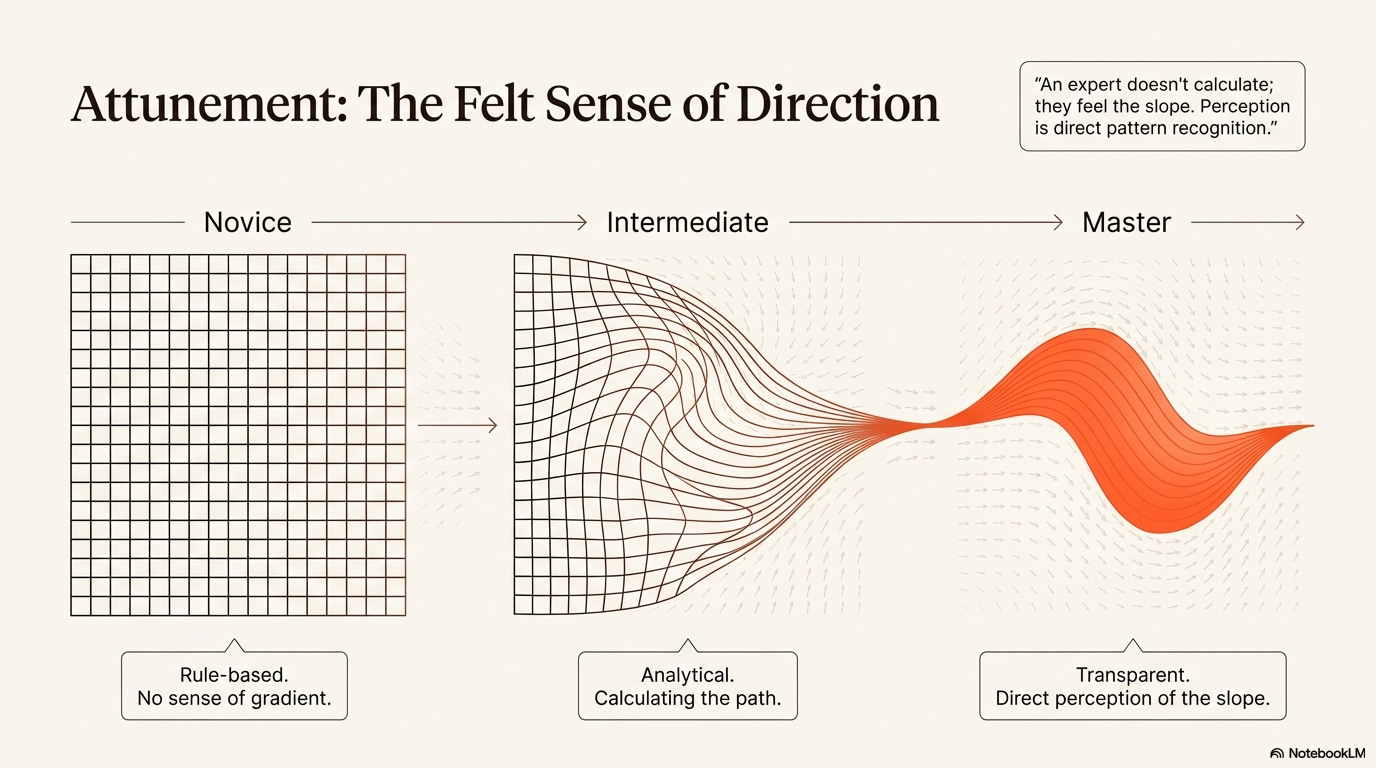
Attunement is developed sensitivity to a pattern’s internal structure, gained through extended engagement. It is a form of skilled perceptual knowledge—not information stored but capacity developed.
An expert musician doesn’t need to calculate why a note is wrong; they can immediately feel its wrongness. This feel is the result of deep attunement to musical patterns, developed over years of practice, feedback, and immersion.
The same applies across domains. The chess grandmaster “sees” that a position is strong without calculating all variations. The experienced physician “senses” that something is wrong before tests confirm it. The wise person “perceives” what the situation calls for. The master carpenter “feels” whether the joint will hold.
Attunement is not mystical. It is the developed capacity to perceive gradients that untrained perception cannot detect. The expert perceives more of the coherence-landscape because their aperture has been refined through practice.
Fallibility and Verification
Attunement is real but fallible. We can misperceive gradients—through inexperience, bias, fatigue, or distortion.
The novice “feels” that a move is strong, but the grandmaster sees it’s weak. The ideologue “perceives” coherence in their position, but they’re caught in an echo chamber. The tired doctor “senses” nothing wrong, but misses a crucial sign.
How do we correct for fallibility? Through convergence and collective verification.
When multiple attuned participants, perceiving from different perspectives, arrive at the same pattern, this suggests the pattern is real—not merely projected. The fact that mathematicians across cultures converge on the same theorems suggests mathematical coherence is objective. The fact that experienced doctors agree on diagnoses suggests medical attunement tracks something real.
This leads us to the crucial collective dimension of participation.
Part Seven: The Collective Dimension
Participation Is Inherently Collective
We have spoken of individual participants perceiving gradients and navigating the coherence-landscape. But even this apparently individual activity is embedded in collective participation at every point.
Consider Andrew Wiles’s proof of Fermat’s Last Theorem. The story seems to be one of solitary genius: seven years of secret work in an attic, finally conquering a problem that defeated the greatest minds for 358 years.
But look closer. Wiles’s proof deployed the Taniyama-Shimura conjecture, developed by Japanese mathematicians in the 1950s. It required Galois representations, the work of a French prodigy who died in 1832. It built on Ribet’s theorem, proved just years before. It drew on centuries of accumulated mathematical insight and technique.
When a gap was discovered in the proof, it was Wiles’s former student Richard Taylor who helped find the way through. The “solitary” proof was actually a moment of collective navigation—one person channeling the participation of thousands across centuries.
Genius is not solitary creation but exceptional navigation of collectively constituted structures.
Collectively Constituted Patterns
Many patterns we navigate are themselves constituted through collective participation. They wouldn’t exist without the collective.
Language emerges through collective communication; no individual invents it. Markets are created through countless exchanges; price is collective information. Scientific knowledge is built through community research, peer review, and replication. Institutions exist because people collectively treat them as existing. Traditions are accumulated attunement transmitted across generations.
The deaf children of Nicaragua provide a striking example. Brought together in new schools in the 1970s-80s, with no exposure to existing sign language, they collectively invented Idioma de Signos Nicaragüense. No individual child invented the language. The grammar emerged through their interactions, through play and communication—through collective participation. The pattern was determined through the collective.
Cognitive Glue
What binds individuals into collectives capable of shared perception and navigation? OR calls this cognitive glue: the mechanisms that enable genuine collective participation.
Cognitive glue includes shared vocabulary and concepts—common language for perceiving and describing patterns. It includes common training and practices—shared ways of engaging that enable coordination. It includes mutual awareness—knowledge of each other’s capacities, roles, and contributions. It includes aligned purposes—shared orientation toward common goals. And it includes coordinating institutions—structures that enable complex collective action.
Without cognitive glue, individuals remain isolated—each perceiving partial gradients, unable to combine into collective perception. With cognitive glue, the collective can perceive patterns invisible to any individual.
Consider a surgical team. Each member—surgeon, anesthesiologist, nurses—perceives different aspects of the patient’s condition. Through shared training, common vocabulary, established protocols, and mutual awareness, they function as a collective intelligence, navigating the complex landscape of the surgery together. The cognitive glue enables perception and action beyond individual capacity.
Stress Sharing
Stress sharing is the distribution of challenges and burdens across the collective. This is not merely efficient division of labor—it involves something deeper.
In biological systems, cells at a wound margin bear disproportionate stress during healing. They divide rapidly, migrate, and many die in the process. These cells “sacrifice” for the organism’s coherence.
Similar patterns appear in human collectives. Parents sacrifice sleep, career, and freedom for children’s flourishing. Teachers bear the burden of transmission so knowledge can persist. Researchers pursue high-risk projects, often failing, so the field can learn what doesn’t work. Activists face persecution so movements can advance. Leaders bear the stress of difficult decisions so groups can function.
Healthy stress sharing is reciprocal over time and across members. It serves collective coherence. Those who bear more are recognized, supported, and can rely on others bearing stress in turn.
Pathological stress sharing is extractive: burdens imposed without consent, without reciprocity, without recognition. This is exploitation—stress taking rather than stress sharing. Understanding the difference is crucial for evaluating collective participation.
Trans-Subjectivity
This collective dimension reveals something important about the coherence-landscape: it is trans-subjective.
The landscape is not private to any individual. It is shared—accessible from multiple perspectives, the same landscape navigated by different participants. This is what makes collective participation possible: we are navigating the same coherence-structure, not isolated private worlds.
Evidence for trans-subjectivity comes from convergence. Mathematicians across cultures arrive at the same theorems. Scientists in different labs replicate results. Musicians trained in different traditions agree about what works. Craftspeople from different lineages converge on similar techniques.
This convergence suggests they are perceiving the same structure. If each were navigating a private landscape, such agreement would be miraculous. Trans-subjectivity explains it: there is one landscape, accessed from many perspectives.
Intersubjective Correctability
Because the landscape is trans-subjective and our perception is fallible, we can correct each other.
Disagreement is meaningful precisely because we’re attempting to perceive the same structure. If each had a private landscape, disagreement would be mere difference of opinion, neither right nor wrong. But if we share a landscape, one of us can be more accurate.
This grounds practices of collective verification: peer review in science, critique in art, dialectic in philosophy, apprenticeship in craft. In each case, more attuned participants help less attuned ones perceive more accurately. The collective achieves attunement that individuals could not achieve alone.
Tradition and Transmission
Attunement is not reinvented from scratch by each generation. It is transmitted through traditions—accumulated wisdom passed down through practices, training, and cultural forms.
Each generation inherits the attunement of its predecessors: ways of perceiving, methods of engagement, sensitivities developed over centuries. The physicist inherits Newton, Maxwell, Einstein. The musician inherits Bach, Mozart, Coltrane. The carpenter inherits generations of anonymous craftspeople whose discoveries are embodied in techniques, tools, and standards.
Tradition is not mere constraint or dead weight. It is accumulated attunement—the collective’s developed sensitivity to coherence-structures, preserved and transmitted so each generation doesn’t start from zero.
Part Eight: Seeing with New Eyes
What OR Offers
Orientational Realism offers a vision of reality as a dynamic landscape of guiding patterns—patterns that are real, normatively structured, and partly constituted through our engagement with them.
In this vision, the world is not a collection of inert objects but a coherence-landscape with topology, gradients, and attractors.
You are not an observer looking in from outside but a participant navigating from within—a pattern among patterns, a process of selfing enacted through an embodied aperture.
Knowledge is not a copy of reality stored in your head but developed attunement—the capacity to perceive gradients that guide navigation.
Meaning is not subjective preference projected onto meaningless matter but coherent participation in real patterns that transcend any individual.
Community is not a collection of isolated minds bridged by communication but a collective participating in shared patterns, bound by cognitive glue, sharing stress, achieving together what none could alone.
Core Implications for Living
What follows from this vision?
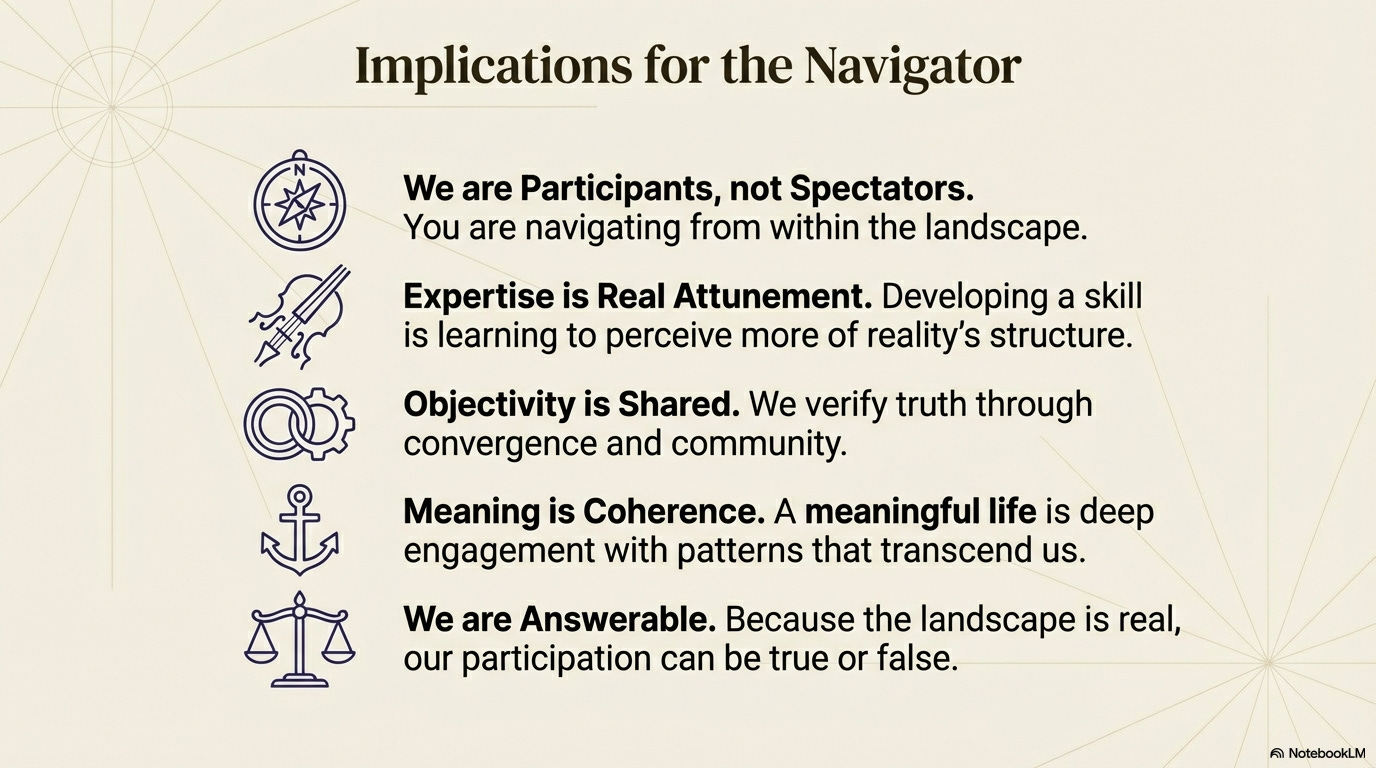
We are participants, not spectators. We don’t observe reality from outside; we navigate it from within. Our engagement is not optional—we are always already participating. The question is whether we participate well or badly.
We are constrained but creative. We don’t make things up arbitrarily; real patterns guide and limit us. But within those constraints, we can genuinely create—determining what was previously open, contributing to what the landscape becomes.
We navigate together. Even our most individual achievements are embedded in collective participation. We navigate landscapes constituted by others, use attunement developed through traditions, and are verified through communities.
Expertise is real attunement. Developing a skill is not just learning facts; it is learning to perceive more of reality’s structure. The expert sees what the novice cannot—not through magic but through developed sensitivity.
Meaning is found in coherent participation. A meaningful life is one of deep and fitting engagement with real patterns that transcend us—patterns that existed before us and will persist after.
We are answerable. Because patterns have real structure—better and worse, more and less coherent—our participation can be done well or badly. We are answerable to the patterns we engage with, to the collectives we participate in, to those who will navigate after us.
Conclusion: An Invitation
Orientational Realism is not a finished doctrine but an invitation—an invitation to see the world as patterns rather than things, to feel the gradients that guide, to understand yourself as a participant rather than a spectator.
Philosophy has often promised to describe reality from an objective standpoint outside it. OR suggests this is impossible and unnecessary. We are always already participating, always already navigating, always already oriented. The question is not whether to participate but whether to participate wisely—with attunement, with awareness, with sensitivity to the gradients that guide.
The coherence-landscape is real. It has structure. It has gradients. We navigate it together, developing attunement, sharing stress, constituting patterns that will guide those who come after.
Understanding this framework requires more than reading. It requires the very participation it describes. You cannot fully grasp attunement without developing it. You cannot understand gradient perception without perceiving gradients. You cannot comprehend the collective dimension without participating in collectives.
The framework points. The reader must look. Participation is required.
Glossary of Key Terms
Pattern: A real structure that persists, is multiply realizable, has causal relevance, and constrains possibility.
Coherence: The relation of fit, consistency, and mutual support among patterns.
Coherence-Landscape: The topology of coherence relations within a domain—its gradients, attractors, and regions.
Gradient: The direction toward greater or lesser coherence at any point in the landscape.
Attractor: A stable region of high coherence that draws nearby configurations toward it.
Participant: A self-maintaining, oriented, responsive pattern capable of perceiving gradients.
Participation: Oriented, responsive engagement with patterns—can be shallow or deep, faithful or unfaithful.
Selfing: The ongoing process of self-organization and self-direction that constitutes personal identity.
Aperture: The model of mind as an opening onto patterns, rather than a container for representations.
Attunement: Developed sensitivity to pattern structure, gained through extended engagement.
Gradient Perception: The direct perception of directions toward greater or lesser coherence.
Trans-Subjectivity: The shared accessibility of the coherence-landscape from multiple perspectives.
Cognitive Glue: What binds individuals into collectives capable of shared perception and navigation.
Stress Sharing: The distribution of challenges and burdens across a collective for mutual benefit.
Fidelity: Participation that honors the coherence-structure of the pattern engaged with.
Orientational Realism: patterns, gradients, participation, together.