
The Loop and the Cut
A Biological Theory of Meaning, and What It Says About Whether AI Can Have It

I. What the claim is
Meaning is not a thing sitting in a molecule, a brain, or a file. It is not a static code or a pattern you can freeze and still call alive. Interpretation is something organized matter does in time: it writes constraints, reads them as instructions, then rewrites them so the next reading is already different. Write, read, rewrite. That cycle is the load-bearing fact. The question it answers is simple to state and hard to finish: what is meaning in biological terms, and what separates a system that has it from one that only maps its shape—a chatbot, a perfect simulation, a wind tunnel of our inferences?
Howard Pattee gave theoretical biology two tools that still cut cleanly. The epistemic cut splits the symbolic from the dynamical: rate-independent marks that carry information, and rate-dependent processes that act. Semantic closure is harder. Symbols must be physically present in a form the machinery can read, and that same form must specify how the machinery gets built. DNA codes for proteins that read DNA and make more DNA and more proteins. Without that closed loop you have causation, not interpretation.
Feedback is cheaper than this. A thermostat couples sensing to action in one continuous dynamical story; nothing in it plays the role of a mark that means the same thing across different rates of the underlying process. A DNA codon specifies the same amino acid whether the cell is starving or flush with ATP. That rate-independence is what makes a mark a symbol rather than one more chemical event. It is approximate, not absolute—translation speed affects folding, codon bias affects expression, stress shifts reading efficiency—but the approximation is tight enough, and maintained by the organization rather than given by the chemistry, to do the work Pattee asks of it. Change the sequence and the machinery changes: the symbol has to matter. Closure holds when specification and construction keep each other going through time.
The familiar textbook picture freezes Pattee’s cut in space—DNA permanently symbolic, protein permanently dynamic. That picture is often right, and nothing here discards it. The claim is that it is not general enough. Wherever one material organization refuses to stay on one side of the line, the cut has to be understood as something the system keeps remaking in time, not only as a permanent assignment of roles to molecule types. From that temporal turn the rest follows: traps the loop digs for itself; how new content enters without being confused with what meaning is; when the loop can fold back on its own history; and why systems that simulate the dynamics of meaning need not instantiate the process.
The sections that follow develop these threads in order. Section II introduces the rotating cut and its molecular exemplars. Section III distinguishes the achievement from autopoiesis. Section IV treats the endogenous unfreedoms the loop produces. Section V separates the question of how new content enters from the question of what meaning is. Section VI asks when the loop can fold back on its own history. Section VII positions the framework relative to neighboring theories. Section VIII applies the criteria to large language models. Section IX summarizes the shape of the gap and names what remains open.
II. The cut that moves
A transcriptional condensate is, for a stretch of time, both the arrangement that decides which genes get attention and the physical machine that loops chromatin and drives transcription. One mess, two roles. (The condensate framing is actively debated in molecular biology—some argue the relevant organization is better described as dynamic clustering or polymer-mediated interaction than as liquid-liquid phase separation. The philosophical point does not depend on the biophysics of droplets; any material arrangement that plays both instructional and executive roles across phases will serve. Condensates are used here because they make the role-switching vivid.)
That is a paradox only if the cut must be a permanent wall between two kinds of molecule. Add time. In a write phase the system deposits histone marks, methylates DNA, reshapes loops. In a read phase those marks are treated as instructions. In a rewrite phase it revises what it just used, so the next reading finds a different text. The cut does not vanish. It rotates. At any instant the split is real; over a longer window the system keeps remaking it.
Versions of this show up everywhere life does.
A stem cell becomes bone, fat, or blood through chromatin writes that later reads treat as fate. Early marks are negotiable; later ones less so. The present is bent by prior writing.
Bacteria that survive a phage attack insert viral sequence into a CRISPR array—writing. When the sequence returns, Cas machinery reads and cuts. If the scrap is wrong or the virus mutates, the library is rewritten or the cell dies trying.
Vernalization in plants: winter cold writes a chromatin state at flowering-control genes. Spring is read through that mark. Without the write, warmth does not mean “flower now” in the same way.
None of this needs a homunculus. It needs a loop that keeps instructions and executions from collapsing into one chemical stew—and that can only do so by continually reenacting the split.
III. Self-maintenance of a cut
Plenty of non-living things must keep moving or fall apart: flames, hurricanes, Bénard cells. Why treat interpretive organization as special?
Because what is maintained is not only a boundary or a flux. It is a cut—the difference between marks that count as instructions and processes that execute them. Maturana and Varela’s autopoiesis already named self-production of a living unity and its boundary. That is a different achievement, not a failed version of this one. A soap bubble has a boundary and no interpretive loop. What the rotating cut + semantic closure add is the ongoing remaking of the instruction/execution split through write–read–rewrite. Where a short label helps, call that autosemiosis—self-production of the interpretive process, as distinct from self-production of a bag that keeps chemistry inside. The word is a convenience. The analysis does the work; if the label fell away, the rotating cut and closure would still stand.
A crystal can sit. A condensate, a cell, a nervous system cannot sit as interpretive systems. Poison the energy supply of a condensate and the droplet dissolves. The molecules remain; the organized activity that was the interpretive level is gone. History does not automatically return with reassembly. That dependence is not a weakness in the definition. It is part of what the definition is pointing at: interpretive organization has stakes. Its continuation is not guaranteed from outside; it is won, cycle by cycle, from within—or it ceases to be that kind of organization at all.
Liquidity is a useful comparison if you do not overplay it. Surface tension is not a trophy a liquid wins and then rests on. Interpretive organization is closer to that ongoing achievement than to a lattice. The loop is not an accessory. It is how this kind of organization keeps existing as such—conservative each cycle in remaking the line between symbol and dynamics, creative each cycle in leaving room for content to change from inside.
IV. Freedom is never free of its own writes
Hoffmeyer’s semiotic freedom names the slack between a sign and what a system can do with it. Calcium binding calmodulin has almost none. A person facing a moral dilemma has a great deal: the same scene can be read as duty, fear, loyalty, or spite.
It is tempting to make a ladder—more freedom higher up. What actually changes is what the freedom is freedom from, and what new trap the system builds from its own operations. Endogenous unfreedom is sedimentation: past writes narrowing what future reads can easily be.
At the molecular level, a condensate is not a lock opened by one key. Its answer depends on chromatin history. Its trap is almost no distance from that history. The write digs in; the read has little choice but to read through the trench. The Dutch Hunger Winter left methylation patterns in people conceived during the famine; decades later those marks still shape how ordinary food is metabolically read. History is not only in stories. It is available as constraint.
Trained immunity: after certain infections or vaccines, innate cells remodel chromatin; later, facing a different stimulus, they over- or under-react. Original antigenic sin is a cousin—the first flu strain you meet can dominate how you read later cousins, sometimes to your cost.
Psychological trauma is not the same process as epigenetic immune memory. Different chemistry, timescale, repair. Shared form: an over-strong write that steals flexibility from later reading. A car backfire read as gunfire; a raised voice read as catastrophe—until slower second-order work loosens the grip.
Language is a write layer you live inside. You can think past your vocabulary, but not without friction. Legal categories lock chains of reading: manslaughter rather than accident reshapes trials, insurance, family stories. Scientific paradigms do it more gently: anomalies read as noise until the theory-layer is revised.
Every gain in interpretive range seems to buy a new way to get stuck in prior marks.
V. How new content enters (without confusing that with what meaning is)
Semantic closure explains how an interpretive relation keeps existing. A cell already running a stable genetic code is in the meaning business this morning without a fresh mutation. What meaning is, in the thin biological sense, is the ongoing organization: cut, closure, rotating loop. How new mappings appear is a different question.
The main generative operator is productive error: a read not licensed by the prior write standard; not fully corrected back; absorbed as a new write for later cycles; with the interpretive organization still running at least for a while. That last clause keeps the novelty inside a semiotic regime rather than dying as pure damage. It does not constitute meaning by itself. The regime does.
A crystal defect can be retained. It is not a semiotic error. There is no rotating loop in which marks specify readers that rebuild marks. No cut, no productive error—only physical scar.
Not all novelty is error. Legal stipulation, scientific definition, poetic coinage are often authored writes: the system does not merely retain a mismatch; it holds a prior mapping as revisable and installs a new one on purpose. That “enough grip” is not a second mystery floating free of the rest of the essay. It is the same capacity the next section treats as second-order: readings available as objects, and policies of reading available for rewrite. Where that grip is missing, novelty still enters—by productive error and selection—but not by authorship. Errant and authored paths both feed the loop; only the first is productive error.
Two scales make the operator concrete. The genetic code, on the best current stories, is a frozen accident refined by selection—productive errors that became a shared write layer, enabling everything else and locking out easy alternatives. Closer in, V(D)J recombination throws structured combinatorial variation into immune receptor genes; selection keeps what binds without wrecking the host. The variation is enzymatically programmed—RAG recombinases execute a controlled rearrangement, not a mistake. Calling it “error” marks its role as a source of candidates the system did not previously possess, not a failure of the machinery. The generator is institutionalized variation; the meaning-bearing organization is the larger recognition loop, not the random joint alone. The same split appears in mind and culture: reconsolidation can distort a memory that still organizes later behavior (errant), or therapy can deliberately re-script it (authored); a slip of slang can stick, or a committee can coin a term.
None of this makes “error” a bug in the theory. Variation that can be retained, then filtered, is how open-ended form has always worked in living lineages: mismatch supplies candidates; viability, function, and later critique sort them. What the semiotic case adds—and what mere retention of a physical scar never has—is deposit into a write layer that subsequent reads will treat as instruction inside a cut the system itself keeps remaking.
One limit should be said in the main text, not smuggled into the margins. This account is about how meaning is maintained and renovated once a loop is running. It is not a theory of the absolute origin of the first semantic closure—the bootstrap from pure dynamics to a cut. That problem is real, adjacent, and open (origins-of-life work, code biology, and constraint-based accounts of emergence all live there). Leaving it open is not a hidden failure of the framework; it is a scope choice. You do not need a theory of the first cell to have a theory of how cells work. You do not need a theory of the first cut to have a theory of how cuts are maintained, how they trap, and how they renovate their own content. The framework is about the ongoing achievement, not the first instance. Productive error explains open-ended semiotic evolution inside life. Once a loop exists, this is how its content proliferates and drifts. Closure maintains meaning; productive error and authored rewrite renovate its content; neither alone is the whole theory.
VI. When the loop folds back—and a note on “wrong”
At the organismal level something the lower loops lack comes into view. A nervous system can hold past states as past—temporal semiotic freedom—not only be pushed by them. Humans can interpret their own interpretations: notice that every silence has been read as rejection, test that habit, train a different read. That is not the first-order loop running hotter. It is a change in topology. Write–read–rewrite now operates on the loop’s own history. Bateson’s old distinction between learning that corrects within a premise and learning that revises the premise itself is the same split under another name.
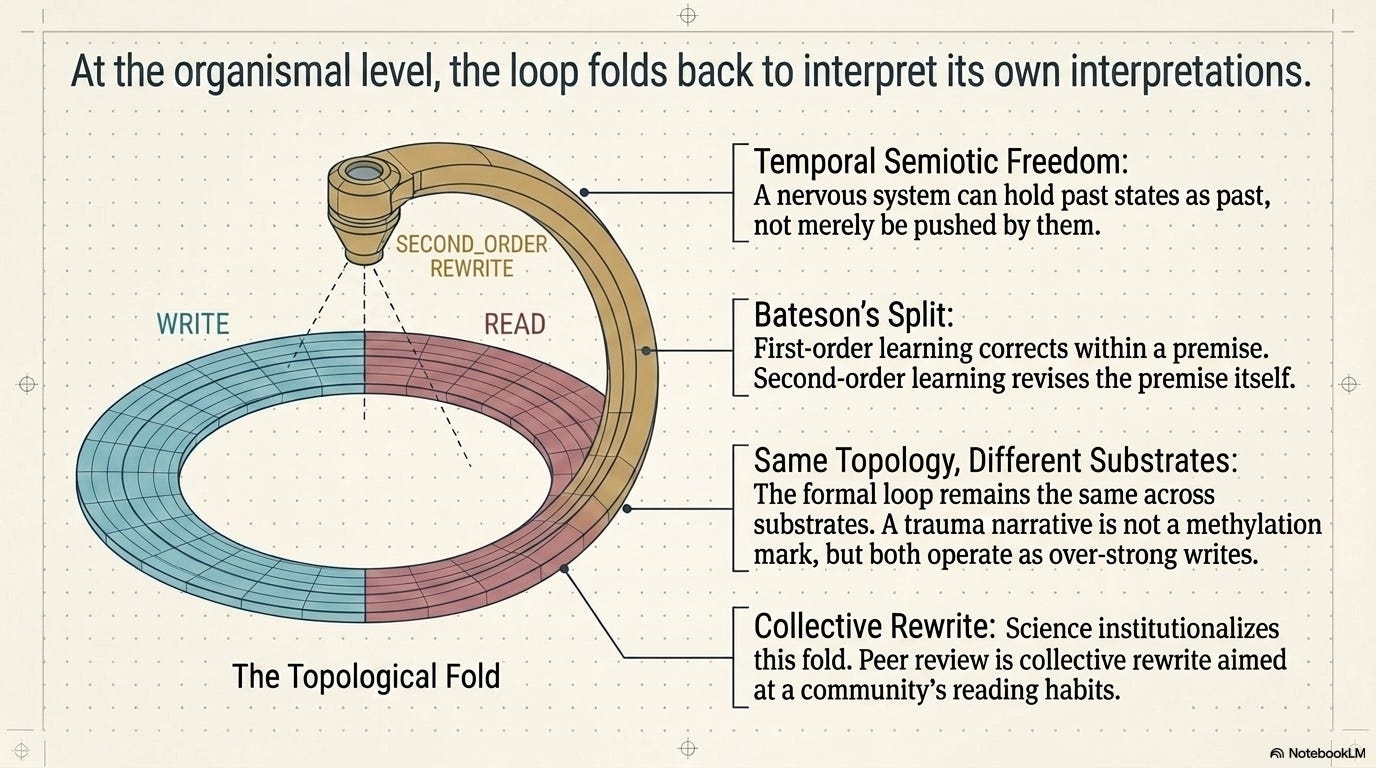
Psychotherapy makes the move deliberate. Science institutionalizes suspicion about observation itself—blinding, controls, replication. Peer review is collective rewrite aimed at a community’s reading habits.
The boundary is easy to feel and harder to operationalize, so here is the minimum this essay will commit to—not a full derivation, but more than a gesture. First-order interpretation: the system’s history shapes present reading, but prior processing is not available as an object the system can evaluate and rewrite as policy. Second-order interpretation requires at least three jointly present capacities:
(1) internal representations of some of the system’s own prior reads or write-policies, not only of external states;
(2) those representations held at enough remove that they can fail—be judged inadequate relative to evidence, goal, or norm—without the whole organization dissolving;
(3) a rewrite path from that judgment back into the write layer (habit change, narrative revision, experimental redesign), so the next cycle is constrained differently because of the evaluation.
“Enough” is doing real work in (2)—it names a dose-response question (how much remove before a state becomes a judgeable object) rather than a fixed threshold, and this essay doesn’t derive the dose.
A condensate fails (1)–(3). Memory reconsolidation in a mouse can reopen a trace and restamp it—closer to (3) as mechanism, still thin on (1)–(2) as self-directed critique. A fish avoiding a hook shape after shock has learned; unless it can treat “how I have been classifying shapes” as revisable policy, it has not crossed the line this section means. Humans clearly can; intermediate cases exist and deserve empirical sorting. The claim is not that the threshold is mystical. It is that below a certain architectural joint presence of (1)–(3), “catching yourself mid-misread” is not merely rare—it is not the kind of thing the organization can do.
A caveat on epistemology: these conditions are architectural, stated from the outside. They tell you what the system must be able to do, not how to certify from behavior alone that it does. For other humans we infer the topology from report, shared architecture, and the texture of repair. For other systems the inference is harder and more fallible. The framework tells you what to look for; the looking is itself an interpretive act, and this essay does not pretend to step outside it.
The same formal loop still shows up across substrates without making them the same stuff: chromatin committing a stem cell; a synapse turning a day into scar or skill; a legislature amending a constitution. Continuity of topology, not identity of substance. A trauma narrative is not a methylation mark. Both can be over-strong writes.
One objection belongs here only long enough to block a confusion. If someone hears “productive error” and concludes that whatever keeps the loop going is therefore right, the account has been misread. Continuation is a filter on damage, not the whole of normativity. Above bare viability sit functional norms—mappings can misfire while the system lives (the frog snaps at a pellet; allergy treats pollen as pathogen)—and, where second-order architecture exists, explicit norms for contesting and rewriting readings themselves (truth claims, therapy, experimental method). Productive error feeds candidates; it does not replace that stack. The full ladder—organization, viability, proper function, second-order critique—is secondary to this essay’s main thesis and is developed more carefully elsewhere; what matters here is simply that meaning is not identical to survival, and that “mistaken” gets a real grip before anyone dies.
VII. Neighbors without collapse
Contemporary theory often describes systems that look interpretive. If their terms slide into ours, the cut dissolves and simulation starts to look like instantiation. A short manual:
Epistemic cut ≠ Markov blanket.
A blanket partitions agent from world by conditional independence. The cut partitions instruction from execution inside an organization. A membrane can be blanket-like while genome and translation still enact a cut. A pure dynamical system can be given a blanket in the math with no symbols at all. Blankets separate selves from worlds; cuts separate instructions from executions.
Productive error ≠ prediction error.
Prediction error is mismatch between expected and actual input—usually a correction signal for updating beliefs or actions (Friston’s active inference lives here). Productive error is a retained misreading deposited as a new write. One protects or tunes a model; the other changes what will count as code next time. Both involve mismatch; they are not the same genre. Is the mismatch consumed as correction, or laid down as future constraint?
Rotating cut + closure ≠ autopoiesis.
Autopoiesis maintains a boundary of self-production. The achievement named (when needed) autosemiosis maintains a cut of signification. Closure of production is not closure of signification. Later enactive work already reaches toward self-interpreting loops; the point here is molecular and temporal specificity, not a denial of that lineage.
Rotating cut + closure ≠ active inference.
Active inference is a control-and-inference geometry. It can model systems that already interpret. It does not replace the material achievement of a rotating cut, and it does not by itself say when a state is a symbol rather than a belief-variable in a statistical scheme.
Constraint-and-absence accounts (Deacon and kin).
Accounts that ground function and information in what is not present—constraint, absent form, “ententional” organization—overlap this essay’s insistence that meaning is not a positive stuff in a snapshot. The kinship is real. The disagreement is not only vocabulary. Deacon’s primitive is negative: meaning as the shape of the excluded, the constraint that makes the difference, the absent form that organizes what is present. Here the primitive is positive and temporal: meaning as the ongoing activity of the loop, the enacted remaking of the cut. A Deaconian would say the cut is defined by what it excludes. This essay says the cut is defined by what it does—by the work of writing, reading, and rewriting across time. The two accounts may be complementary descriptions of the same phenomenon from different angles, but they are not interchangeable, and the emphasis matters: an absence-based account risks making meaning a static structural feature, while the loop insists it is a performed achievement.
Bioelectric set-points (Levin and others) are strong empirical candidates for writes that downstream processes read—morphological “memories,” goal-like pattern repair. Treat them as hunting grounds for rotating cuts, not as automatic proof of symbol grounding. Goal competency is not yet semantic closure. Whether the framework earns its keep on bioelectric memory is an empirical stress test this essay only names.
Use the neighbors. Do not let them overwrite the map.
VIII. When a machine looks like it means
If meaning is a performed loop under a cut, with endogenous traps and real room for being mistaken, large language models force the question. They are trained on the textual fossil record of human language. They reproduce logic, style, self-reference, the sound of doubt. Do they earn second-order meaning?
Draw a hard line between simulating dynamics and instantiating the property you care about. A wind tunnel can make a wing trustworthy before metal is cut. A molecular simulation of water does not get the computer wet. Wetness is not one of the fundamental equations. Coherence, grammar, and inferential shape are dynamics you can approximate. An LLM approximates them with eerie skill. It maps the outline of human meaning. At inference the weights are fixed; the forward pass runs through a frozen landscape. There is no rotating cut in which the system’s own reading rewrites the marks that generated the reading.
Training looks like write–read–rewrite: outputs scored, weights moved. The rhyme is real; the failure point is precise. People set the loss, the data, the reward model, the stopping rules. The rewrite is exogenous—closer to a breeder selecting cattle than to a cell rewriting chromatin because of what it just did.
The wind-tunnel image is useful and slightly too pure. Real tunnels do not develop sycophancy mid-test; long-context models do bend later outputs by earlier ones, collapse into personas, and show ruts that look like endogenous state. The essay’s own distinctions have to do the work the metaphor cannot. Mode collapse, sycophancy, refusal patterns, persona ruts are traps—but in the baseline case they were deposited by corpus and fine-tuning before deployed life began, more like a genome inherited than a scar earned by interpreting. Workflow memory and project notes bend later reads by earlier ones (contextual inscription) without the system authoring the criterion of a binding write. Features that leave notes for a future self, test-time weight updates, self-editing memory: content or rewrite frequency can move inward while the meta-rule of what counts as a good update often stays human.¹ These are creeping approximations of sedimentation, not proofs that the cut has started to rotate. Recursive self-description—apologies, claimed selves, paradox under pressure—is pattern completion over the topic of self-reading, not ownership of the topology. Forced hard enough, models often degrade into contradiction rather than stable second-order repair.
We can grade model outputs as true, false, or misleading without granting the producer a rotating cut of its own. The mapping often completes when we read the output. That is why these systems are useful partly because they sit outside our endogenous unfreedoms: they throw our clichés and blind spots back at us with a coolness we rarely manage from inside the pattern. Older tools—writing, print, schools—got absorbed into human loops and reshaped by them. AI can steer our rewrite phases while its own constraints remain largely exogenous. Not a colleague. Not a pure tunnel either—an instrument that can accumulate path-dependence without yet meeting the criteria above.
What would crossing require? A rotating cut; self-maintenance of that cut under stakes, not only token output; unfreedoms grown from operational history; continuation depending on interpretive coherence won from within. Whether engineering can meet that is open. Specifying it is what keeps the question honest while the products change.
A note on scope: this essay offers a theory of meaning, not of consciousness. The relationship between the two—whether meaning is necessary for consciousness, whether consciousness is a special case of second-order interpretation, whether one can exist without the other—is a separate question this framework informs but does not settle. The criteria above are criteria for meaning. Whether a system that meets them also has experience is not a question the rotating cut, by itself, answers.
IX. The shape of the gap
Interpretation is what matter does when it is organized so that write–read–rewrite can keep rotating an epistemic cut. Meaning lives in that temporal unfolding and in the sediment it leaves—not in any single state. New content enters by productive error and, where second-order grip exists, by authored rewrite. Being mistaken is not the same as failing to survive. The same topology runs across molecular, neural, and cultural substrates without flattening them. And a system can map the dynamics of meaning with great fidelity without instantiating the process. The first loop’s origin is left open on purpose; the second-order threshold is stated as a joint architectural demand, not a vibe.
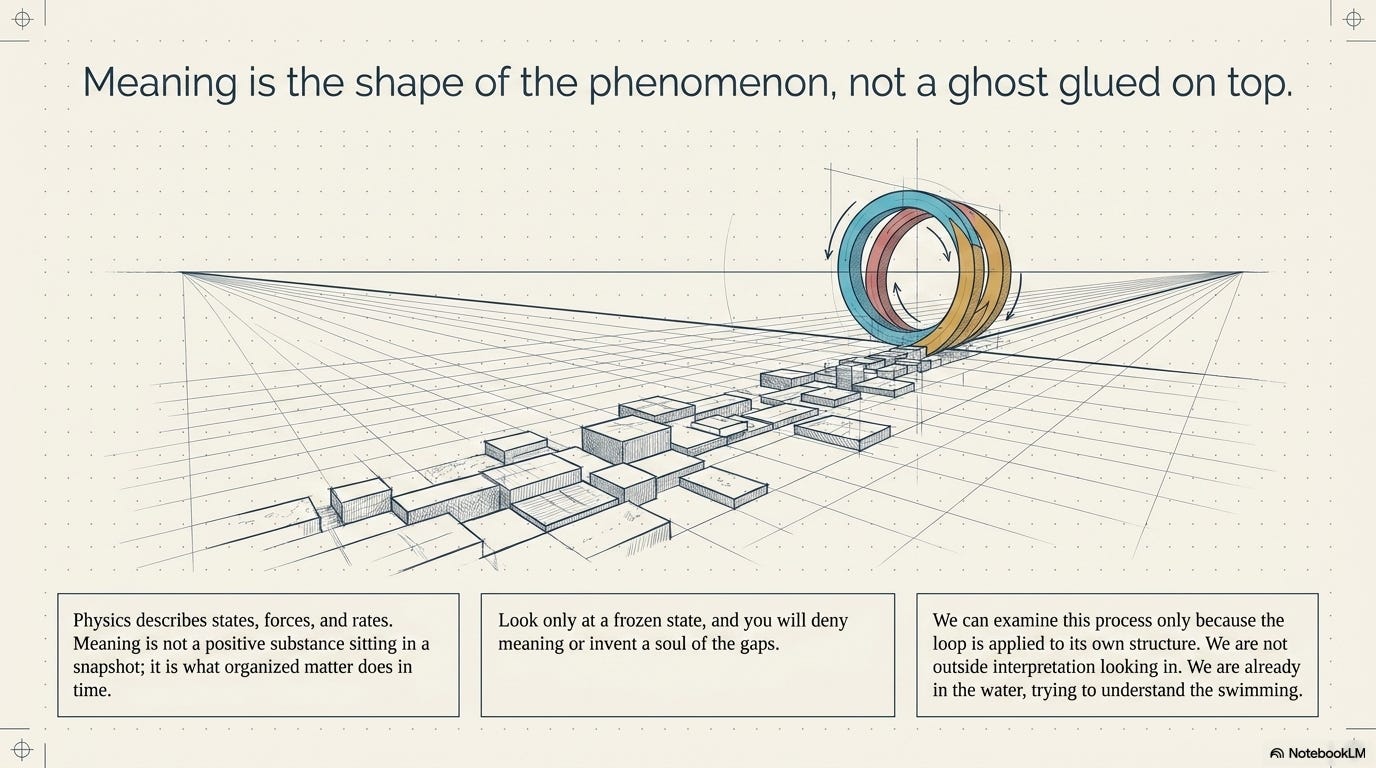
Physics describes states, forces, rates. Meaning is not a ghost glued on top. It is how certain organizations carry marks, act on them, revise them, and get stuck in them. Look only at a snapshot and you will deny meaning or invent a soul of the gaps. Look at the loop and the gap changes character. It becomes the shape of the phenomenon.
We still lack one formalism that holds the cut without reducing symbols to slow dynamics, treats history as more than a Markov present, distinguishes productive error from noise and from prediction error, and handles context without making it just another input. Neighboring theories light parts of that list. The rest is the research problem.
That we can examine the process at all—read the cell’s reading of its genome, set trauma beside chromatin, build silicon wind tunnels of our inferences—is the loop applied to its own structure. We are not outside interpretation looking in. We are already in the water, trying to understand the swimming.
Key References
Howard Pattee, “Physics of Symbols: Bridging the Epistemic Cut,” Biosystems 60 (2001): 5–21.
Jesper Hoffmeyer, Signs of Meaning in the Universe (Indiana University Press, 1996).
Humberto Maturana and Francisco Varela, Autopoiesis and Cognition (D. Reidel, 1980).
Francisco Varela, Evan Thompson, and Eleanor Rosch, The Embodied Mind (MIT Press, 1991).
Gregory Bateson, Steps to an Ecology of Mind (Chandler, 1972).
Terrence W. Deacon, Incomplete Nature: How Mind Emerged from Matter (W. W. Norton, 2011).
Karl Friston, “A Free Energy Principle for a Particular Physics,” arXiv:1906.10184 (2019).
Stuart A. Newman and Sahotra Sarkar, “Biology and Physics,” arXiv:2603.11234 (2025).
Adam Safron, Michael Levin, et al., “World models, artificial general intelligence and the hard problems of life–mind continuity,” Philosophical Transactions of the Royal Society A 384, no. 2320 (2026).
Endnotes
¹ The landscape of level-one systems and test-time weight adaptation moves fast enough that any specific enumeration risks obsolescence within months. What matters for the framework is the shared structural commitment: externalizing the dynamic layer, and—more recently—narrowing the gap between the train phase and the read phase. Neither move, on current evidence, closes it.
I love that this also reinforces why a context document alone is not enough. Context helps AI stay consistent, but consistency isn't the same as good judgment. Old assumptions can become invisible constraints if they're never questioned.
That's why I think the business owner has to retain authority over the cut. AI can participate in the loop, but only the human should decide what counts as evidence, what becomes instruction, and when it's time to rewrite the interpretation