
The Flaw Is Source Code
Buehler, Boden, and the Physics of Radical Creativity

In the previous article, “Radical Creativity: A Synthesis of Boden, Schmidhuber, and Gabora”, we charted the territory of radical creativity through three lenses: Boden’s map of conceptual spaces, Schmidhuber’s compression engine, and Gabora’s honing of the inner world. We arrived at a definition: radical creativity is the act of inventing a new primitive — stepping outside the walled garden and bringing something entirely new back in.
But a question lingered. We described what radical creativity produces and how it feels. We even described the computational reward that drives it. What we didn’t have was a physics of the transition — a concrete account of the mechanism by which a system stuck inside one conceptual space crosses over into a genuinely new one. We could point at the wall of the garden and say “the radical creator goes over it.” We couldn’t say what the wall is made of, what breaks it, or how the specific pattern of the breaking tells you where to go next.
Markus Buehler — a materials scientist at MIT who studies how things break, how things hold together, and what the pattern of failure tells you about the path to something stronger — provides the missing physics. And when his ideas are set alongside Boden’s taxonomy, something remarkable happens: two distinct paths to radical creativity become visible, each with its own mechanism, its own character, and its own implications for the future of artificial intelligence.
The Scientist Who Reads Cracks
Buehler studies materials — spider silk, bone, proteins, engineered composites. His career has been spent asking a deceptively simple question: when something breaks, what does the pattern of the break tell you?
The answer, it turns out, is everything.
When a ceramic cup shatters on a stone counter, the crack starts at a small chip in the rim — a pre-existing weakness. It propagates along lines where the glaze is thin, where the clay is slightly uneven. The shards are not random. They are a map of the cup’s vulnerabilities, revealed by stress.
An engineer who can read this map knows not just that the cup failed but what the cup would need to become to handle the stress that destroyed it. The crack pattern encodes the specific mismatch between the material’s current architecture and the demands placed on it.
Buehler’s summary is blunt: “The flaw is source code.”
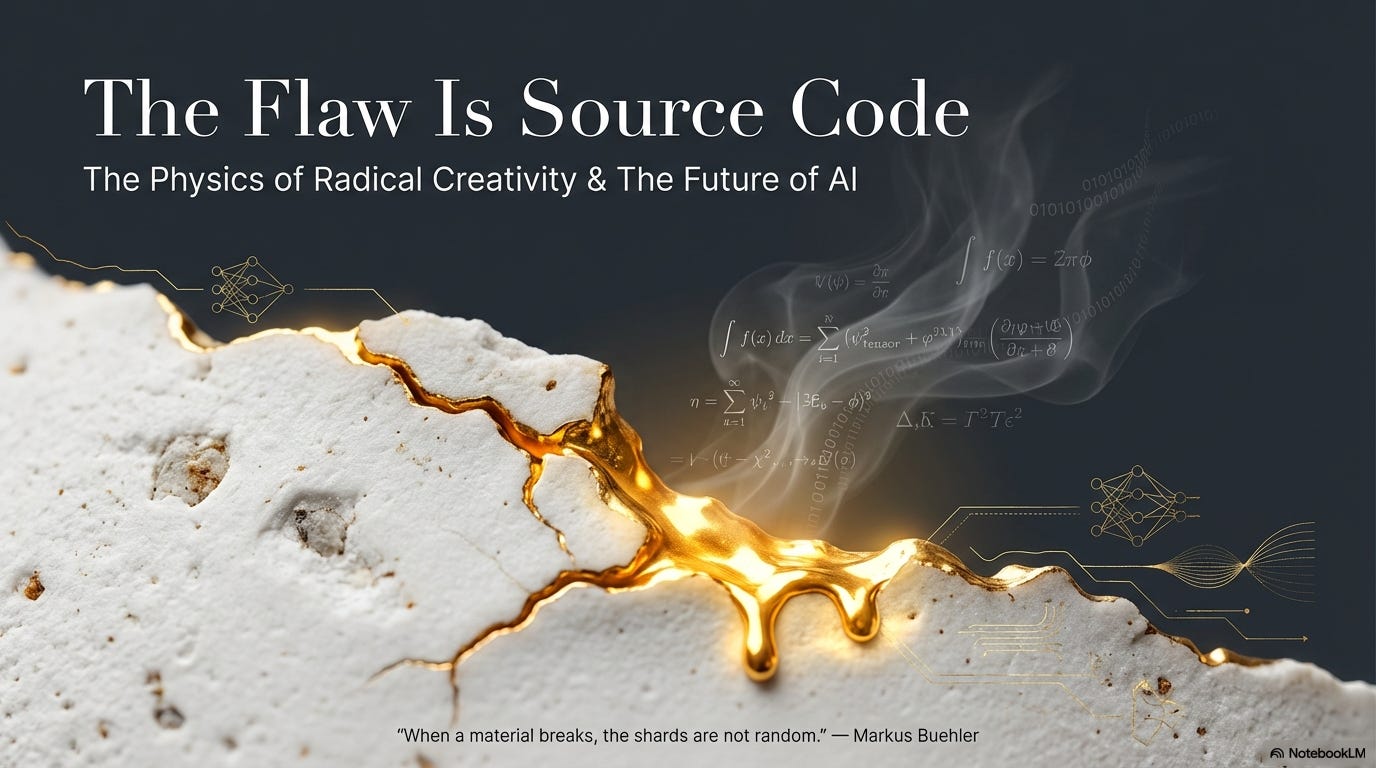
Not noise. Not meaningless breakdown. But a message written in the language of physics — a diagnostic readout of exactly where the current structure is inadequate and exactly what the next structure needs to handle.
From Cracks to Creativity
Now consider what happens when we lay this insight over Boden’s framework.
In the previous article, we described three kinds of creativity: combinational (novel recombination of familiar elements), exploratory (finding new possibilities within established rules), and transformational (changing the rules themselves). We noted that transformational creativity is the most radical — it doesn’t just find new paths in the walled garden but tears down the wall and builds a new garden.
But we didn’t have a good account of what triggers the transition from exploratory to transformational. Schmidhuber’s compression theory gave us a computational criterion: when the current compressor encounters fundamentally incompressible data, it must be replaced. Gabora’s honing theory gave us the experiential criterion: when psychological entropy reaches a critical threshold, the worldview must restructure.
Buehler gives us the physical criterion, and it is more specific than either: the pattern of failure within the current conceptual space is itself the blueprint for the new space.
When a scientist explores a well-established theory — pushing it into new domains, testing its predictions against new data, probing its boundaries — they are doing what Buehler calls interpolation: finding new solutions within an existing constraint map. This maps directly onto Boden’s exploratory creativity. The rules are fixed. The space is defined. The scientist is finding new corners of the walled garden.
But eventually, the scientist encounters resistance that the current theory cannot resolve. Anomalies accumulate. Predictions fail. Phenomena appear that the existing framework has no vocabulary to describe. In Buehler’s language, the theory cracks under stress.
And here is the crucial insight: the specific pattern of the crack — which predictions fail, in what domains, under what conditions — is not random noise. It is a structured readout of exactly what the current theory is missing.
Buehler calls this the distinction between interpolation and discovery. His favourite example is vivid: imagine training an AI on everything humanity knew about fire 40,000 years ago. Ask it for new ways to produce energy. It will give you bigger fires, new fuels, clever arrangements of combustion. A thousand variations, all within the chemistry of burning. But it will never give you fusion — because fusion requires stepping back from the entire framework of chemical combustion and recognizing that matter and energy have a deeper relationship, that you can release energy by fusing atomic nuclei rather than burning anything.
The fire-to-fusion leap is not a bigger fire. It is a different kind of understanding — one with new variables, new invariants, and new symmetries that simply do not exist within the chemistry of combustion. No amount of interpolation within the fire-space will reach fusion, no matter how creative the interpolation.
This is Boden’s transformational creativity given physical precision. But how, exactly, does the transition happen? It turns out there are two very different paths — and understanding both reveals a hidden seam in Boden’s framework that changes the picture fundamentally.
The Hidden Seam: Shallow and Deep Combination
Boden identifies combinational creativity as the most familiar form: making novel connections between existing ideas from different domains. A collage. A metaphor. An analogy between atomic structure and solar systems. The elements are familiar; the combination is new.
Buehler’s own research program — mapping the structural grammar of spider silk onto musical composition, social networks, and protein folding — looks at first glance like textbook combinational creativity. He takes two established domains, finds connections between them, and produces insights that neither domain contained alone.
But look closer at what he is actually doing, and a crucial distinction emerges — one that Boden’s framework, as originally stated, does not make.
Shallow Combination
A hip-hop producer samples a 1970s funk bassline and sets it to a new beat. A poet describes grief as “a stone in the chest.” A management consultant tells a struggling restaurant owner that “your business is like a garden — you need to prune the dead branches.” An AI chatbot, prompted to connect materials science and cooking, writes: “Both spider silk and soufflés depend on getting the structure right.”
These are all combinational — novel connections between familiar ideas. And they are all shallow. They operate through surface association: things that share superficial features, that can be juxtaposed in ways that produce a flash of recognition. The connection is real — there is something genuinely shared between silk and soufflés — but it is a connection of resemblance, not of structure. You cannot use the physics of silk to make a better soufflé, and you cannot use the chemistry of soufflés to make stronger silk. The connection illuminates but does not transfer.
More examples make the pattern clear. A motivational speaker says “the immune system is like an army defending a castle.” Evocative. Memorable. But you cannot use military logistics to design a vaccine. A TED talk compares the internet to a nervous system. The analogy gestures at something real, but it doesn’t tell you how to build a better network by studying neurons, or how to understand neuroscience by studying routers.
Shallow combinational creativity is, in Buehler’s terms, interpolation in a very high-dimensional space. The AI chatbot that connects silk and soufflés is navigating the embedding space of language — a vast landscape where everything is connected to everything through smooth associative pathways. It finds a path from one concept to another and produces a sentence that traverses the path. The path is novel. The connection is real. But it is a connection within the existing space, not a bridge to a new one.
Deep Combination
Now consider what Buehler actually does when he maps silk onto music.
He doesn’t look for surface resemblances. He doesn’t say “silk is like music because both are beautiful.” Instead, he builds formal representations of the mechanistic structure of each domain. How does silk achieve strength? Through hierarchical organisation: molecular bonds form fibrils, fibrils form fibres, fibres form threads, threads form webs. At each level, the composition rules — how lower-level elements combine to produce higher-level properties — follow specific patterns. How does music achieve tension and resolution? Through hierarchical organisation: notes form intervals, intervals form chords, chords form progressions, progressions form movements. At each level, the composition rules follow specific patterns.
He then asks: are the composition rules — the structural grammar, not the surface features — the same? And he finds that they are. Not metaphorically. Formally. Using the mathematical tools of category theory, he identifies precise, structure-preserving maps between the organisational logic of silk and the organisational logic of music.
This is deep combinational creativity. It doesn’t just connect two domains through association. It reveals that two domains share constraint structure — that they are, at a formal level, governed by the same underlying organisational principles. And this structural bridge, unlike the associative bridge, transfers. If you discover a new organisational principle in silk mechanics, the bridge tells you where to look for the analogous principle in music — and vice versa.
Here are examples of deep combination from across the sciences:
Darwin’s natural selection. Darwin didn’t just notice that pigeon breeding looks like species change. He recognised that the mechanism of artificial selection (variation + selective retention over generations) is structurally identical to a mechanism that could operate in nature without a breeder. The bridge was structural, not metaphorical, and it transferred: understanding how breeders improve pigeons told you precisely how nature could produce adapted organisms — through the same mechanism operating on the same principles, without intention.
The genetic code and information theory. When molecular biologists realised that DNA functions as a code — not metaphorically but structurally, with the same formal properties as codes in communication theory (encoding, transmission, error correction, redundancy) — this wasn’t a pretty analogy. It was a structural bridge that allowed tools from one domain (Shannon’s information theory) to solve problems in another (understanding mutation rates, gene expression, error correction in replication).
Epidemiology and network theory. When researchers recognised that disease spread and information spread share the same structural dynamics — the same differential equations governing propagation through networks — they could transfer tools from one domain to the other. Understanding how viruses spread through populations told you how rumours spread through social networks, and vice versa, because the underlying constraint structure was formally the same.
The difference between shallow and deep combinational creativity is the difference between noticing that two maps have similar coastlines and discovering that two maps are projections of the same globe. The first is a curiosity. The second is a transformation of understanding.
The Horizontal Path: Across Domains
Why does the shallow/deep distinction matter so much? Because deep combinational creativity is not just a fancier version of shallow combination. It is one of the two primary mechanisms by which the transition from exploratory to transformational creativity actually occurs. We call it the horizontal path — it works by going across, building structural bridges between different explored domains until the bridges reveal something that neither domain contained.
Consider how it works historically.
Maxwell’s electromagnetic field. Maxwell combined electricity and magnetism — two well-explored conceptual spaces with established laws. This started as deep combinational creativity: building a structural bridge between two domains. But the bridge revealed something neither domain contained alone. Electricity and magnetism were aspects of a single electromagnetic field, governed by new equations that predicted phenomena (electromagnetic waves, the constancy of the speed of light) invisible from within either domain alone. What began as deep combination became transformation: a new primitive, a new conceptual space, a new set of rules.
Crick and Watson’s double helix. They combined X-ray crystallography, Chargaff’s base-pairing rules, and structural chemistry. Each was an explored domain. The deep structural bridge between them revealed the double helix — a structure that none of the individual domains predicted but that the shared constraints demanded.
The transistor. Vacuum tube electronics had been explored exhaustively. Engineers knew its limits: tubes were fragile, hot, power-hungry, and large. Bardeen, Brattain, and Shockley at Bell Labs built a deep structural bridge between electrical engineering and quantum mechanics. They recognised that semiconductor physics offered a different mechanism for controlling electron flow — not by heating a filament in a vacuum but by manipulating quantum states in a solid crystal. The variables were different, the physics was different, but the function — controlling electron flow to process information — was structurally the same. The deep bridge nucleated the transistor, which produced the integrated circuit, which produced the computer revolution.
The pattern is consistent: deep combinational creativity builds the structural bridges across which transformational creativity travels. The bridge reveals a deeper principle. The deeper principle transforms the spaces it connects.
But this is only one of the two paths. There is another, and it often produces even more fundamental transformations.
The Vertical Path: Through the Floor
Some of the most profound transformations in human understanding have come not from bridging domains but from pushing so deep into a single domain that the explorer breaks through the floor and discovers that the ground was not solid — that beneath the rules they were navigating lay a deeper space with different rules entirely.
This is the vertical path: exploratory creativity pushed to such extremes that it becomes transformational — not by connecting gardens but by discovering that the garden has a basement.
What the Vertical Path Looks Like
Consider what happens when a scientist, artist, or mathematician doesn’t bridge to another domain but instead pushes relentlessly deeper into their own. They explore every corner. They test every boundary. They apply the rules with absolute rigour to every case, including cases the rules were never quite designed for. And eventually, in some cases, the rules themselves start to buckle.
This is different from the normal course of exploratory creativity, where the explorer finds new and surprising things within the space. The vertical path finds the places where the space itself is incomplete — where the rules, followed faithfully to their logical conclusions, produce contradictions, absurdities, or infinities that reveal that the rules were always approximations of something deeper.
The crack doesn’t come from outside (from the collision of two domains). It comes from inside — from the accumulated pressure of the domain’s own internal contradictions, exposed by relentless, exhaustive exploration.
And Buehler’s principle still applies: the flaw is source code. The specific pattern of the internal contradiction — where it appears, what form it takes, which cases trigger it — is a diagnostic readout of what the deeper space must look like.
The Ultraviolet Catastrophe
Perhaps the purest example of the vertical path in the history of science.
In the late 1890s, physicists were exploring classical thermodynamics applied to a specific problem: how does a heated object radiate energy at different frequencies? This was not a cross-domain problem. It was solidly within classical physics — thermodynamics and electromagnetism, both well-established, applied to a concrete physical situation.
They followed the rules faithfully. They applied the established equations with full rigour. And they got an absurd answer: at high frequencies, the classical theory predicted that a heated object should radiate infinite energy. This was called the ultraviolet catastrophe — not because anything catastrophic happened physically, but because the mathematics produced a catastrophe: an infinity where a finite answer should be.
This was the domain cracking from within. The rules of classical physics, followed to their own logical conclusion, produced a result that classical physics could not accommodate.
Max Planck, working entirely within this single domain, proposed a fix that he himself considered a mathematical trick: what if energy isn’t continuous but comes in discrete packets — quanta? He didn’t import this idea from another field. He didn’t build a bridge to chemistry or biology. He was trying to make the mathematics work within his own domain, and the only way to avoid the infinity was to introduce a new variable — the quantum of action — that had no precedent in classical physics.
The “trick” turned out to be a new primitive. It opened the conceptual space of quantum mechanics — a space with fundamentally different rules, where energy is quantised, where particles behave as waves, where measurement changes what is measured. None of this was visible from within classical physics. It became visible only because someone pushed classical physics so deep that it broke, and the pattern of the break — an infinity at high frequencies, removable only by discretising energy — pointed precisely at the new space.
Gödel’s Incompleteness
For two thousand years, mathematicians explored geometry, arithmetic, and algebra within frameworks they assumed were complete — every true statement could, in principle, be proved. In the early twentieth century, logicians attempted to formalise this assumption: build a complete, consistent logical foundation for all of mathematics.
Kurt Gödel didn’t bridge mathematics to another domain. He went deeper into mathematics itself — specifically, into the logical structure of formal systems. He used the tools of arithmetic to study arithmetic. He encoded logical statements as numbers and then asked what happens when a formal system talks about itself.
What he found was a crack from within: in any sufficiently powerful formal system, there exist true statements that the system cannot prove. The system is necessarily incomplete — not because we haven’t been clever enough, but because completeness is structurally impossible. The rules of the garden, followed with perfect rigour, prove that the garden cannot contain all truths.
The specific pattern of the crack — self-referential statements that assert their own unprovability — was a diagnostic readout of the fundamental structure of formal systems. It pointed toward a new understanding of what mathematics is: not a complete edifice waiting to be mapped, but an inherently open domain where truth always exceeds proof.
Cantor’s Infinite Staircase
Georg Cantor was exploring a seemingly simple concept: how do you count things? How do you compare the sizes of collections? These questions lived entirely within set theory and arithmetic — a single domain.
He pushed the concept of “how many” deeper and deeper. Are there as many fractions as whole numbers? Yes — he proved a one-to-one correspondence. Are there as many real numbers as whole numbers? And here the floor cracked. He proved that no, there are more real numbers than whole numbers — that there are different sizes of infinity.
This was not just a surprising result within the existing framework. It was a new primitive: the concept of transfinite cardinality, which required a fundamentally new way of thinking about number, size, and infinity. Cantor didn’t bridge set theory to physics or biology. He drilled into set theory until set theory revealed that it was bigger than anyone had imagined.
Beethoven’s Late Quartets
In the arts, the vertical path is equally visible.
Beethoven spent decades mastering the conceptual space of Classical music — sonata form, tonal harmony, motivic development. He became arguably the greatest explorer of that space, pushing it to its edges with the Eroica Symphony, the Appassionata Sonata, the Fifth Symphony. Each work found new corners of the garden — surprising, powerful, unprecedented — but still within the rules of tonal music.
Then, in his final years, deaf and isolated, he wrote the late string quartets. These works don’t abandon tonality — that would be Schoenberg’s transformational act, decades later. But they push tonal conventions to such extremes that the conventions become nearly transparent — you can see through them to something else. The Grosse Fuge uses dissonance, rhythmic violence, and structural complexity so far beyond anything the Classical framework was designed for that contemporaries found it incomprehensible.
Beethoven didn’t bridge music to another domain. He drilled so deep into the space of tonal music that he reached the point where the rules strained and buckled under the weight of what he was trying to express. And in the specific pattern of how they strain — the dissonances that the harmonic language can barely contain, the formal structures that stretch beyond recognisability — you can hear the outline of the music that would come after: the chromaticism of Wagner, the atonality of Schoenberg, the expressive extremes of the twentieth century.
The cracks in Beethoven’s late work were the source code for a century of musical transformation.
Riemann’s Curved Space
When Bernhard Riemann delivered his habilitation lecture in 1854, he was exploring the foundations of geometry — a single domain. But he explored it so thoroughly, questioning assumptions so basic that most mathematicians didn’t even recognise them as assumptions, that he dissolved the floor beneath the entire edifice.
Euclid’s geometry assumes flat space. Riemann asked: what if space itself has curvature? What if the very stage on which geometry is performed is not fixed but variable?
This was not a bridge to another domain. It was the deepest possible question within geometry itself: what are we actually assuming when we do geometry, and what happens when we stop assuming it? The answer — Riemannian geometry, the mathematics of curved spaces — was a new conceptual space that didn’t just extend Euclidean geometry but revealed it as a special case, a flat island in an ocean of possible curvatures.
Sixty years later, Einstein used Riemannian geometry as the mathematical language for general relativity. The vertical path through pure mathematics provided the foundation for a phase transition in physics.
Two Kinds of Fracture
In Buehler’s materials science, there are two fundamentally different ways a material can fail, and they map precisely onto our two paths.
Interface failure. The crack forms at a boundary — a grain boundary, a phase boundary, the interface between two different materials in a composite. This is where different structural orders meet, where there is mismatch and friction. The failure is driven by the incompatibility between adjacent structures.
This is the horizontal path. The crack forms at the boundary between domains. Different conceptual orders meet, produce friction, and the friction reveals deeper structure that unites them.
Intrinsic failure. The crack forms within a single, uniform material — not at a boundary but within the bulk. This happens when the applied stress exceeds the theoretical strength of the material itself. The material doesn’t fail because of a mismatch between structures. It fails because the stress exceeds what any arrangement of its current atoms can withstand. It hits its own fundamental limit.
This is the vertical path. The crack forms within a single domain, pushed past its own fundamental capacity. The rules, followed to their logical extremes, produce results the rules cannot accommodate.
The two failure modes have different characters:
Interface failure (horizontal path) is more common, because interfaces are natural weak points. It can be engineered — bring diverse domains into contact and the grain boundaries form naturally. Deep combinational creativity can be facilitated by creating interdisciplinary encounters.
Intrinsic failure (vertical path) is rarer, because it requires extreme depth and pressure. It cannot be easily engineered — it requires obsessive, exhaustive, world-class mastery of a single domain combined with the courage to keep pushing when the foundations start to shift.
But there is a pattern worth noting: the vertical path, when it succeeds, often produces more foundational transformations than the horizontal path.
Gödel’s incompleteness theorems are more foundational than most cross-domain analogies. Quantum mechanics (born from the ultraviolet catastrophe) is more foundational than most interdisciplinary bridges. Cantor’s transfinite numbers are more foundational than most combinational insights. Riemann’s generalised geometry is more foundational than most cross-domain mappings.
Why? Because the vertical path attacks the foundations of a domain — the assumptions so deep that they are usually invisible. The horizontal path reveals connections between domains, which is powerful but typically leaves the foundations of each domain intact. The vertical path reveals that the foundations themselves are cracked — that the ground the garden stands on is not bedrock but another layer of structure, previously hidden.
In every case, the old space isn’t destroyed. It is revealed as a special case — a flat region in a curved landscape, a first floor above a basement, a small clearing in a much larger forest. The vertical path doesn’t tear down the walled garden. It discovers that the garden is on a hillside, and there are gardens below.
The Productive Error
Both paths — horizontal and vertical — depend on a principle that Buehler draws from the physics of resilient materials: the generative power of imperfection.
A perfectly uniform material — a flawless single crystal — is paradoxically fragile. A single crack propagates through the entire structure with nothing to stop it. The crystal shatters catastrophically because it has only one mode of response: perfection until destruction.
A composite material — with deliberate heterogeneity, with softer regions next to stiffer regions, with grain boundaries and controlled imperfections — is tough. When stress is applied, the heterogeneity provides multiple response modes. The crack encounters a boundary and is deflected. Stress is distributed across different pathways. The material bends, yields, absorbs — but does not shatter. The imperfections are not weaknesses. They are the material’s source of resilience.
This principle shows up across every domain:
In jazz. The “wrong” note played with conviction becomes a blue note — a tension that gives the music its emotional power. Charlie Parker’s genius was not in avoiding errors but in playing notes that should have been wrong and making them the most interesting thing in the room. His “mistakes” opened doors that correct playing kept shut.
In science. Alexander Fleming’s contaminated petri dish — a failure of laboratory hygiene — revealed penicillin. But it wasn’t just luck. Fleming was attuned to the anomaly. He read the failure pattern (the ring of dead bacteria around the mould) as diagnostic information. A less attentive scientist would have thrown the dish away.
In technology. Slack began as an internal communication tool for a failing video game company called Tiny Speck. The game failed. But the team noticed that the tool they had built to coordinate their own work was more interesting than the product they were trying to build. They read the failure pattern of their original project and found, encoded in it, the blueprint for a billion-dollar company.
In evolution. Mutations are errors in DNA replication. Most are harmful or neutral. But the rare beneficial mutation — the productive error — is the entire engine of evolutionary innovation. A species that replicated its DNA perfectly, with zero errors, would never evolve. It would be a single crystal: perfect, static, and doomed.
Buehler’s principle: a system that eliminates all error eliminates its own capacity for discovery. This applies to both paths. On the horizontal path, the productive error is the unexpected connection — the “wrong” association between domains that turns out to reveal shared structure. On the vertical path, the productive error is the “wrong” result — the contradiction or absurdity that turns out to reveal the limits of the current rules.
This is why AI-generated text reads as flat despite being fluent. Large language models are trained to predict the most likely next token — the canonical average of how good writers write. They converge toward the safe centre of the distribution, eliminating the deviations, the imperfections, the idiosyncratic errors that make individual voices distinctive. The result is writing that pleases everyone and moves no one. It is the literary equivalent of a flawless single crystal — technically perfect and devastatingly brittle.
The reinforcement learning from human feedback that makes AI outputs safe, helpful, and pleasant is the equivalent of engineering out all defects from a material. It produces a system that never fails — and therefore never learns from failure — and therefore never discovers anything genuinely new.
Phase Transitions: How Spaces Actually Transform
Both paths — horizontal and vertical — converge on the same destination: a phase transition in the space of understanding.
In physics, a phase transition occurs when a system’s state changes qualitatively. Ice melts into water. Water boils into steam. At each transition, the system’s behaviour changes so fundamentally that you need different equations to describe it. The variables that matter in one phase become irrelevant in the next. New variables — ones that didn’t exist in the old description — become essential.
Phase transitions have specific preconditions, and both paths to radical creativity generate these preconditions — but in different ways:
Sufficient Pressure
You need enough accumulated stress to drive the transition. Ice doesn’t melt at -20°C no matter how long you wait. Similarly, a comfortable system that handles all the challenges it encounters will never be driven to transformation. You need anomalies. You need failures. You need cracks.
On the horizontal path, the pressure comes from cross-domain mismatches — incompatibilities between domains that demand resolution. Maxwell’s pressure came from the fact that electricity and magnetism produced linked effects that neither domain’s laws could explain alone.
On the vertical path, the pressure comes from pushing rules to their internal limits. Planck’s pressure came from the fact that classical physics, applied rigorously to blackbody radiation, produced infinity. Gödel’s pressure came from the fact that formal logic, applied rigorously to itself, produced unprovable truths.
Proximity to a Boundary
The system must be near the edge of what its current framework can handle. A system interpolating smoothly in the comfortable centre of its conceptual space is far from any phase boundary.
On the horizontal path, proximity means working at the interface between domains — where different conceptual orders meet and create friction. Crick and Watson were at the interface of crystallography, chemistry, and biology.
On the vertical path, proximity means working at the deepest foundations of a single domain — where the most basic assumptions are exposed. Riemann was at the foundation of geometry itself, questioning assumptions so deep that most mathematicians didn’t recognise them as assumptions.
Fluctuations
Random thermal energy is what pushes molecules across a phase boundary. In creativity, fluctuations are the productive errors — the deviations from the canonical model that occasionally open pathways to a new phase.
On the horizontal path, the fluctuation is the “wrong” association — the connection between domains that shouldn’t work but does. Darwin’s fluctuation was taking seriously the structural identity between artificial and natural selection.
On the vertical path, the fluctuation is the “wrong” result — the contradiction or absurdity that shouldn’t happen but does. Planck’s fluctuation was taking seriously a mathematical trick (energy quantisation) that had no physical justification in classical theory.
Nucleation Sites
A new phase doesn’t appear everywhere simultaneously. It nucleates at specific sites — defects, impurities, interfaces — and grows from there.
On the horizontal path, nucleation sites are the deep structural bridges between domains. The formal mapping between two domains provides the seed around which a new conceptual space can crystallise.
On the vertical path, nucleation sites are the internal contradictions, the limit cases, the places where the rules break down. The ultraviolet catastrophe was the nucleation site for quantum mechanics. Gödel’s self-referential construction was the nucleation site for incompleteness.
Phase Transitions from the Horizontal Path
Lavoisier’s oxygen revolution. For decades, chemists explained combustion through phlogiston — a hypothetical substance released during burning. The theory worked for simple cases, but anomalies accumulated: some metals gained weight when burned, the opposite of what releasing phlogiston should produce. The nucleation came from Lavoisier’s deep structural bridge between combustion and respiration: he recognised that both processes involved the same gas (oxygen) in the same structural role. The old space (phlogiston chemistry) underwent a phase transition into the new space (oxygen chemistry), with entirely new variables and new explanatory principles.
The Impressionist break. For centuries, Western painting operated within the rules of academic realism: accurate drawing, historical subjects, smooth finish, studio lighting. Monet and his contemporaries were working at the edges of this space — painting outdoors, confronting light that didn’t behave the way studio convention said it should. The nucleation was a deep structural insight born from the friction between painterly convention and direct observation: what if painting is not about depicting objects but about capturing perception itself — the raw experience of light hitting the retina before the mind organises it? This was a new primitive that transformed the space, and a generation of artists poured through the opening.
The endosymbiotic revolution. Lynn Margulis noticed that mitochondria and chloroplasts had their own DNA, their own ribosomes, their own double membranes — features anomalous within standard cell biology but exactly what you’d expect if mitochondria were once free-living bacteria engulfed by a larger cell. Her nucleation site was a deep structural bridge connecting cell biology to ecology (symbiosis) and evolutionary theory — three explored domains whose structural connection revealed a mechanism that none contained alone. Cells were rewritten as ancient partnerships.
Phase Transitions from the Vertical Path
Non-Euclidean geometry. For two thousand years, mathematicians tried to prove Euclid’s fifth postulate (the parallel postulate) from the other four. They failed. Each failed proof was a crack — revealing specific constructions that depended absolutely on the parallel postulate and could not be derived without it. Gauss, Bolyai, and Lobachevsky performed the transformational act: they asked what happens if you simply deny the fifth postulate. The answer was not chaos but a new, self-consistent conceptual space — an entirely new geometry with different rules and different theorems. The specific pattern of how the old proofs failed told them exactly which new spaces were possible.
The transistor (vertical dimension). We described the transistor above as a horizontal bridge, and it was — but it also had a vertical component. Vacuum tube engineers, pushing their technology to its limits, encountered intrinsic failure: the heated filament itself was the fundamental bottleneck. No refinement within the conceptual space of thermionic emission could escape the heat, fragility, and power consumption that the filament imposed. The diagnostic pattern of failure — always the filament, always the heat, always the vacuum — pointed precisely at what needed to be eliminated. The quantum mechanical bridge provided the alternative; the vertical pressure within vacuum tube engineering provided the necessity.
The Two Paths Converge — and Intertwine
Despite their different mechanisms, the horizontal and vertical paths converge on the same destination: a new conceptual space with new primitives, new rules, new degrees of freedom.
And they often intertwine. The vertical path produces the raw material — the foundational insights, the revealed assumptions, the deeper structures — that the horizontal path then connects across domains:
Riemann’s vertical exploration of geometry produced the curved-space mathematics that Einstein later combined (horizontal path) with the physics of gravity to produce general relativity.
Cantor’s vertical exploration of infinity produced the transfinite mathematics that later became foundational across topology, analysis, and theoretical computer science — horizontal connections to multiple domains.
Planck’s vertical discovery of the quantum later combined (horizontal path) with chemistry to produce quantum chemistry, with information theory to produce quantum computing, with cosmology to produce quantum field theory.
The vertical path goes deep and hits new bedrock. The horizontal path goes wide and builds bridges. The deepest transformations often require both: a vertical insight that reveals new foundational structure, followed by horizontal connections that spread the new primitive across domains.
Or, occasionally, the reverse: a horizontal bridge between domains reveals a structural principle that, when pursued vertically, goes deeper than either domain imagined. Darwin’s horizontal bridge (breeding + population dynamics + biogeography) produced the principle of natural selection, which, pursued vertically, led to the modern synthesis, molecular evolution, and eventually to the recognition that selection operates at every level from molecules to ecosystems — far deeper than Darwin’s original bridge could see.
What This Means for AI
The two-path framework tells us something specific about why current AI systems, for all their power, remain stuck at the level of interpolation — and what would need to change.
Current AI training regimes systematically violate the preconditions for phase transition on both paths:
The horizontal path is blocked because single models trained on single objectives provide no interfaces between differently organised knowledge domains. There are no grain boundaries, no structural meeting points where deep combinational bridges can form. And the training objective — predict the most likely next token — produces shallow associative connections, not the deep structural mappings that nucleate genuine transformation.
The vertical path is blocked because AI systems are not designed to push any single domain to its limits with the kind of relentless, exhaustive rigour that exposes internal contradictions. When a model encounters a domain where its predictions fail, it doesn’t sit with the failure and study it. It doesn’t read the pattern of how and where it breaks. It simply produces a wrong answer, receives a correction signal, and adjusts its weights to be less wrong next time. The failure is treated as noise to be minimised, not as source code to be read.
Both paths require the capacity for productive error — the willingness to take seriously the specific pattern of how things break. Current training regimes suppress this capacity:
RLHF and safety training optimise for outputs that don’t fail.
Benchmark optimisation rewards performance at the comfortable centre, not exploration at the edges.
The training objective converges on the canonical average, eliminating exactly the productive errors — the “wrong” notes, the contaminated petri dishes, the failed proofs — that nucleate both horizontal and vertical discovery.
Buehler’s multi-agent systems — where diverse AI agents with different capabilities interact, challenge each other, seek contradicting evidence, and force world-model rewiring — represent an attempt to engineer the preconditions for horizontal phase transition. Sufficient diversity produces grain boundaries. Sufficient adversarial pressure accumulates constraint failure. Sufficient autonomy allows productive errors. Sufficient structural coupling enables deep bridges between domains.
But the vertical path poses a harder challenge for AI. It requires not diversity of agents but depth of exploration — the ability to push a single domain’s rules to their logical extremes and recognise when the results are not merely wrong but diagnostically wrong — when the pattern of failure reveals that the rules themselves are incomplete.
This is not entirely speculative. Systems like AlphaProof and AlphaGeometry push deep into mathematical domains — not bridging to other fields but exploring mathematical spaces with computational exhaustiveness that exceeds human capacity. They haven’t yet produced Gödel-level insights, but they are pushing deep enough to find results that surprise human mathematicians. They are exploring the garden with a thoroughness that might, eventually, reveal that the garden has a basement.
The key requirement for AI on the vertical path is the same as for humans: the system must be able to recognise its own failure patterns as diagnostic information, not as errors to be corrected. When the system pushes into a region where its current model fails, it must not just note the failure and retreat. It must read the failure — parse the specific pattern of how and where the model breaks down — and use that pattern as a map to what lies beyond.
Current AI systems are trained to minimise failure. The vertical path requires a system that can sit with failure, study failure, and use failure as source code. This is a fundamentally different relationship with error than current training objectives produce.
What the Cracks Are Telling Us
Let us return to where we started: the broken cup on the counter.
The crack that began at the chip in the rim and propagated along lines of hidden weakness was not a failure to be lamented. It was a message — a diagnostic readout of the cup’s specific vulnerabilities, encoded in the geometry of its own destruction.
In our previous article, we defined radical creativity as inventing a new primitive: stepping outside the walled garden and bringing something entirely new back in. Buehler’s contribution is to show us that there are two ways out of the garden: across the wall (horizontal, through deep bridges to other domains) and through the floor (vertical, through exhaustive exploration that reveals deeper spaces beneath the current one). In both cases, the cracks — the specific patterns of failure — are not obstacles to the journey but its source code.
Boden gave us the map. Schmidhuber gave us the engine. Gabora gave us the inner experience. Buehler gives us the physics — the specific mechanism by which constraint failure is metabolised into new degrees of freedom, by which the pattern of how things break becomes the blueprint for what they need to become.
And he gives us one warning that our age of AI needs desperately to hear: a system that cannot fail productively cannot discover. The smooth, confident, endlessly agreeable outputs of our most powerful AI systems are not evidence of intelligence approaching creativity. They are evidence of a system that has been engineered — at great expense and with great skill — to suppress the very mechanism by which creative intelligence actually works.
The cracks are where the light gets in. But only if you leave enough structure to crack, enough imperfection to nucleate, enough error to explore, and enough attunement to read what the failure pattern is trying to tell you.
The critical prediction remains: The path from AI-as-interpolator to AI-as-discoverer requires developing the capacity for both deep structural mapping across domains (horizontal) and exhaustive, honest, failure-reading exploration within single domains (vertical). The challenge is not to make models bigger but to develop architectures and training regimes that support structural depth, tolerate productive error, and operate near the phase boundaries where genuine transformation becomes possible.
The deeper prediction: Different AI architectures may be suited to different paths. Multi-agent swarms with diverse models may be best positioned for horizontal discovery — creating the grain boundaries and interfacial friction from which deep combinational bridges emerge. Single models trained for extreme domain-specific depth — pushing mathematical or scientific domains to their logical limits with computational exhaustiveness — may be best positioned for vertical discovery. The most powerful creative AI systems may combine both: deep vertical explorers connected through horizontal bridges, each path feeding the other in the same way that Riemann’s vertical mathematics fed Einstein’s horizontal physics.
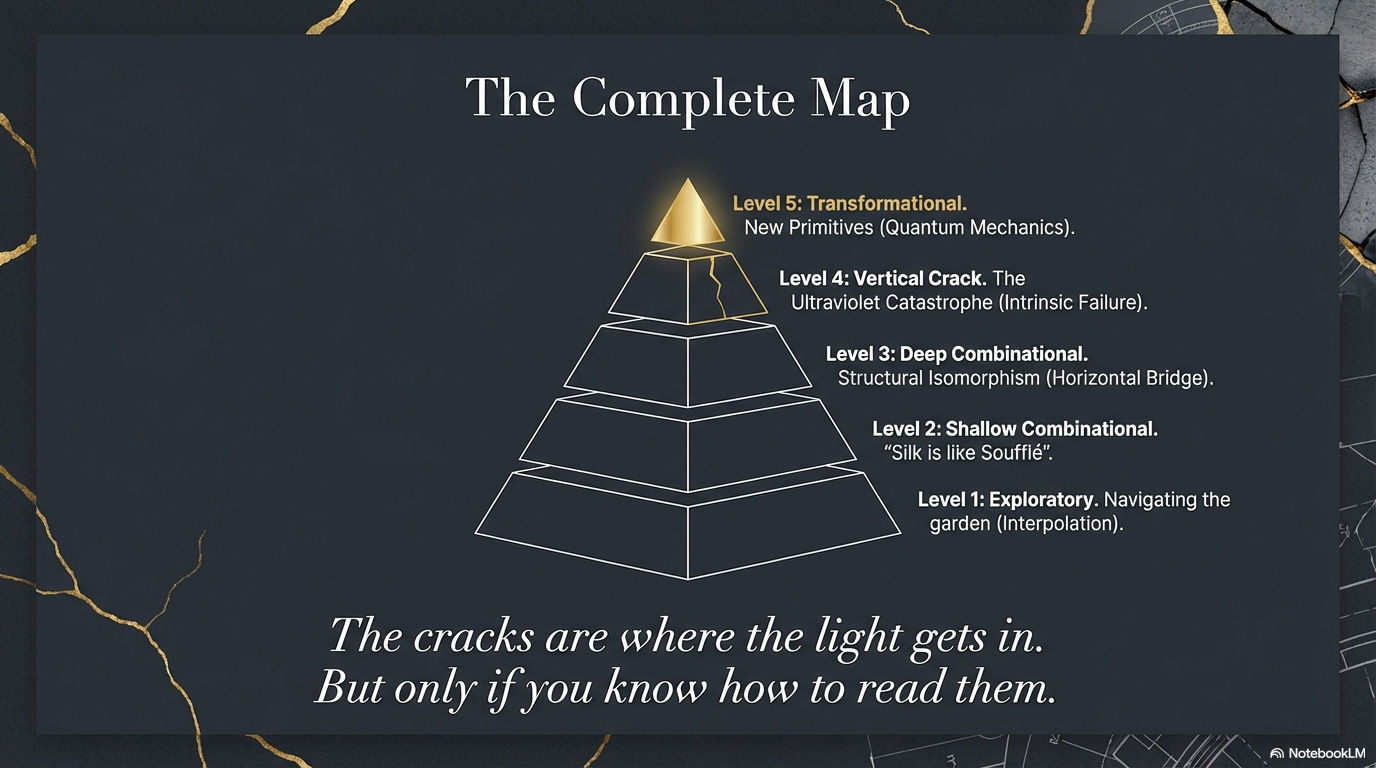
The flaw is source code. The crack is the map. Whether it forms at the interface between domains or deep within the foundations of a single domain, its specific pattern carries the information needed to build what comes next.
Key References
Boden, M. A. (2004). The Creative Mind: Myths and Mechanisms (2nd ed.). Routledge.
Schmidhuber, J. (2009). “Driven by Compression Progress: A Simple Principle Explains Essential Aspects of Subjective Beauty, Novelty, Surprise, Interestingness, Attention, Curiosity, Creativity, Art, Science, Music, Jokes.” arXiv.
Gabora, L. (2016). “Honing Theory: A Complex Systems Framework for Creativity.” arXiv.
Giesa, T., Spivak, D. I., & Buehler, M. J. (2011). “Reoccurring Patterns in Hierarchical Protein Materials and Music: The Power of Analogies.” BioNanoScience, 1(4), 153–161.