
A Year-End Recap: Counter-Intuitive Truths for Thinking in the Age of AI
Do We Need A New Framework of Thinking?

Note: As the year 2025 is coming to a close, we look back at the posts of Extendedbrain.Substack to recognize some patterns and common themes. Here we choose to present the perspective of counter-intuitive thinking. In doing so we are aware that other important topics, such as “The Bow-tie architecture” and “Collective Intelligence” are not covered. These will be revisited soon.
❄️ Seasons Greetings🎄
Introduction: Why Our Intuition About the Mind Is Often Wrong
We have always been fascinated by the architecture of our own minds. In an age where we are building artificial minds to work alongside our own, this curiosity has only intensified. Yet for all our interest, many of our intuitive beliefs about how we learn, think, and create are collapsing under the weight of evidence from cognitive science.
The purpose of this guide is to challenge five powerful myths with counter-intuitive truths. These are not isolated facts but interconnected principles that offer a new, more effective framework for navigating a complex world. Understanding this hidden architecture is no longer an academic exercise; it is an essential skill for thinking in the age of AI.
Myth #1: We See Reality As It Is
The Myth: The Objective Eye. This is the common-sense belief that our senses—our eyes, ears, and touch—act as a direct and passive window onto reality. We assume we are simply receiving information from the world exactly as it is.
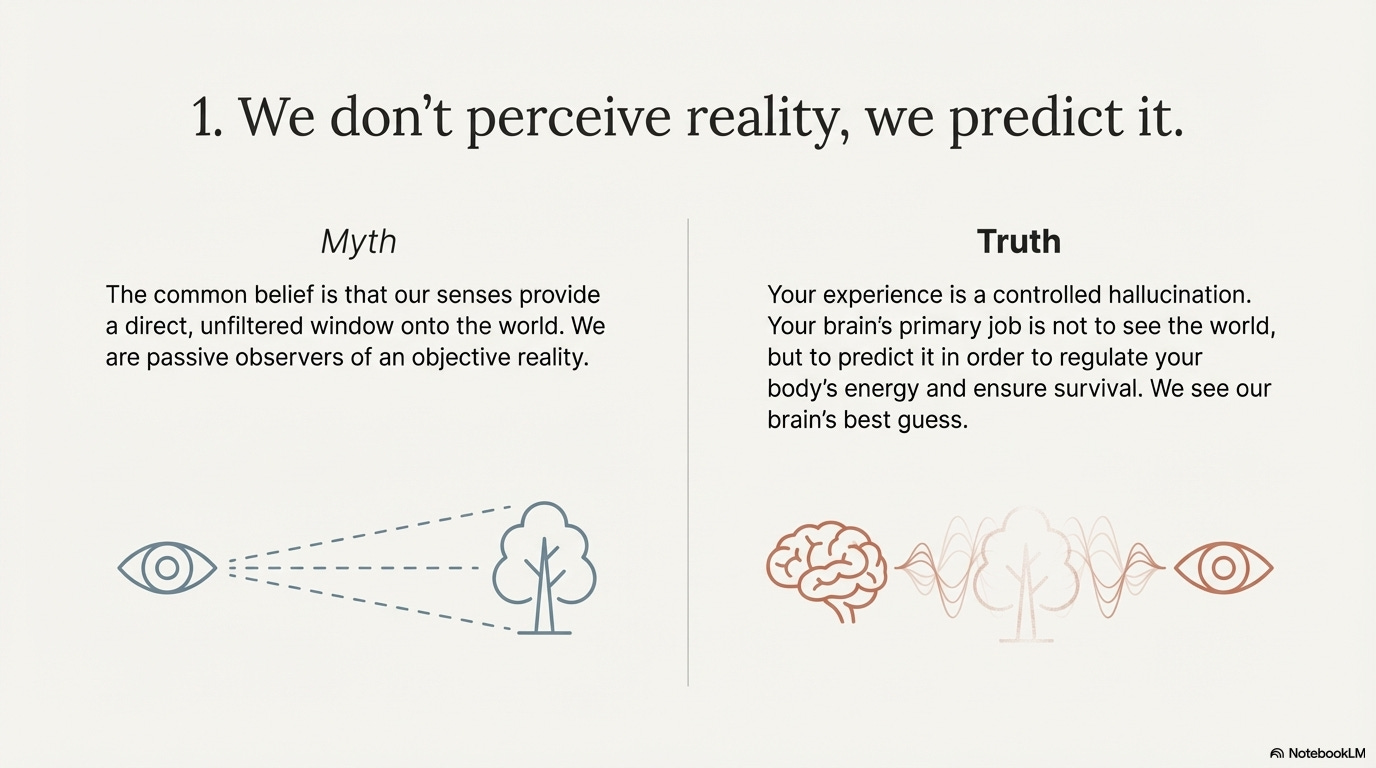
The Truth: The Predictive Brain. The reality is far stranger. Your brain doesn’t see the world directly; it actively predicts it. Your experience of the world is a “controlled hallucination,” a continuous forecast your brain generates based on the concept of predictive coding. The brain’s primary job is not thinking but allostasis: the efficient regulation of the body’s energy to ensure survival. Prediction is its fundamental energy-management strategy.
The Deeper Dive: How Prediction Works. This predictive process operates on a simple, three-part logic:
We see what we expect to see. Our brain generates a forecast of what it believes is out there based on past experiences and current models.
We only notice when our predictions are wrong. The brain is an error-detection machine. It doesn’t pay attention to what it gets right, only to the “surprise” of a mismatch between prediction and reality.
We update our beliefs or act to change the world. When faced with an error, the brain can either update its internal model (learning) or act on the world to make reality match its prediction, whichever is more efficient for minimizing surprise.
The Practical Insight. Understanding this reveals that personal biases are not a moral failing but a natural function of our predictive models. We never see the world directly; we see it through the lens of our expectations. True learning, then, is the difficult but necessary process of updating those models when evidence proves them wrong.
This internal struggle to update our predictions is not a bug, but a feature—it is the very engine of learning, a principle we will now explore.
Myth #2: Learning Should Be Fun and Easy
The Myth: Frictionless “Edutainment”. In an era of apps and bite-sized content, a popular idea has taken hold: effective learning should be easy, frictionless, and entertaining. If it feels hard, something must be wrong with the method.
The Truth: Deep Learning Requires Resistance. The opposite is true. Deep, lasting learning demands what cognitive scientists call “cognitive resistance” or “cognitive friction.” Just as a muscle must work against a heavy weight to grow stronger, the brain needs to struggle against difficulty to encode memory deeply and build new neural circuits.
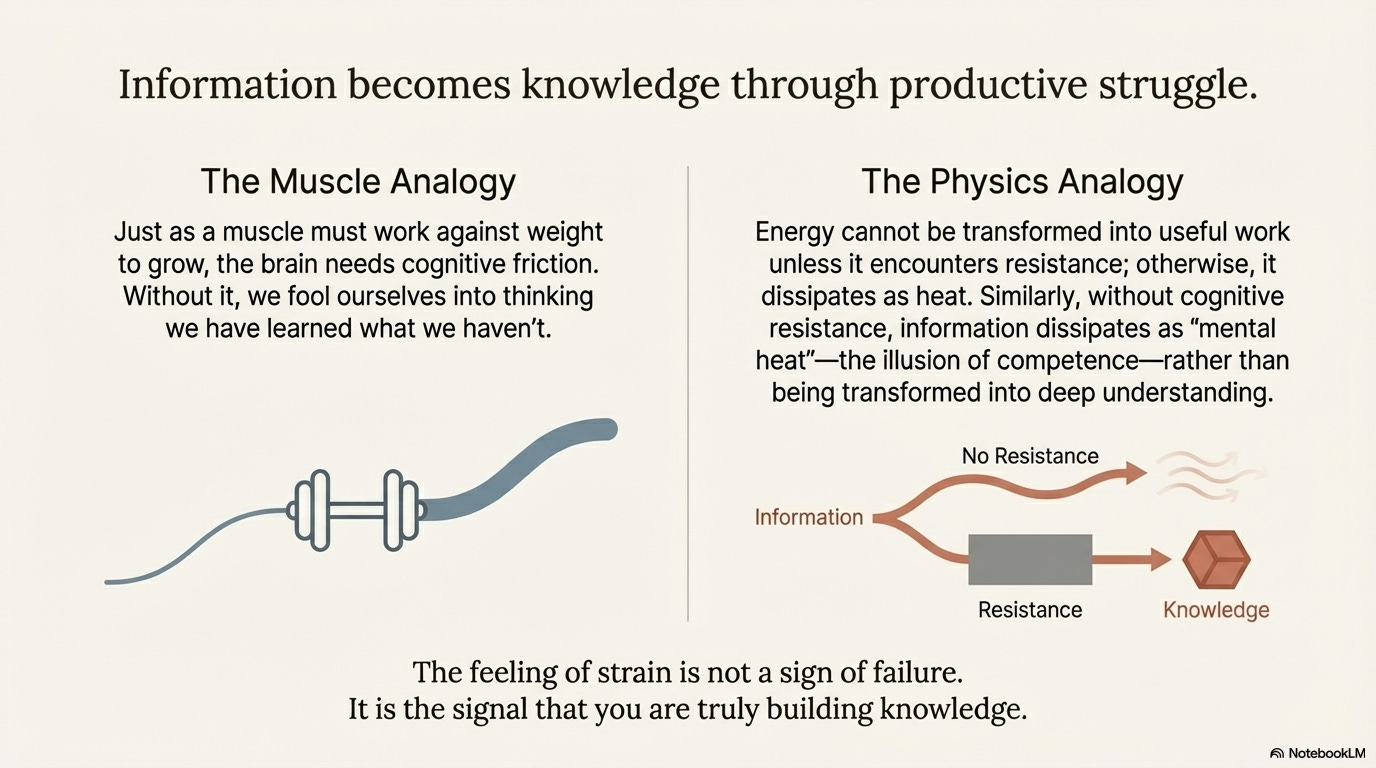
The Deeper Dive: The Feeling of Effort. Without this friction, it’s easy to be deceived. As psychologist Robert Bjork warns, “We fool ourselves into thinking we have learned things that we haven’t.” As AI researcher Andrej Karpathy notes, the feeling of effort is the whole point.
“Learning is not supposed to be fun... the primary feeling should be that of effort... You want the mental equivalent of sweating.”
There is a powerful physics analogy for this process. Energy cannot be transformed into useful work unless it encounters resistance; otherwise, it simply dissipates as heat. Similarly, without cognitive resistance, new information dissipates as “mental heat”—the dangerous illusion of competence—rather than being transformed into deep, durable understanding.
The Practical Insight. You must reframe the feeling of mental strain. It is not a sign that you are failing or “not getting it.” That feeling of effort is a clear signal that you are genuinely building knowledge.
Just as our minds require internal resistance to learn, our creativity thrives when it pushes against external resistance.
Myth #3: Creativity Requires Absolute Freedom
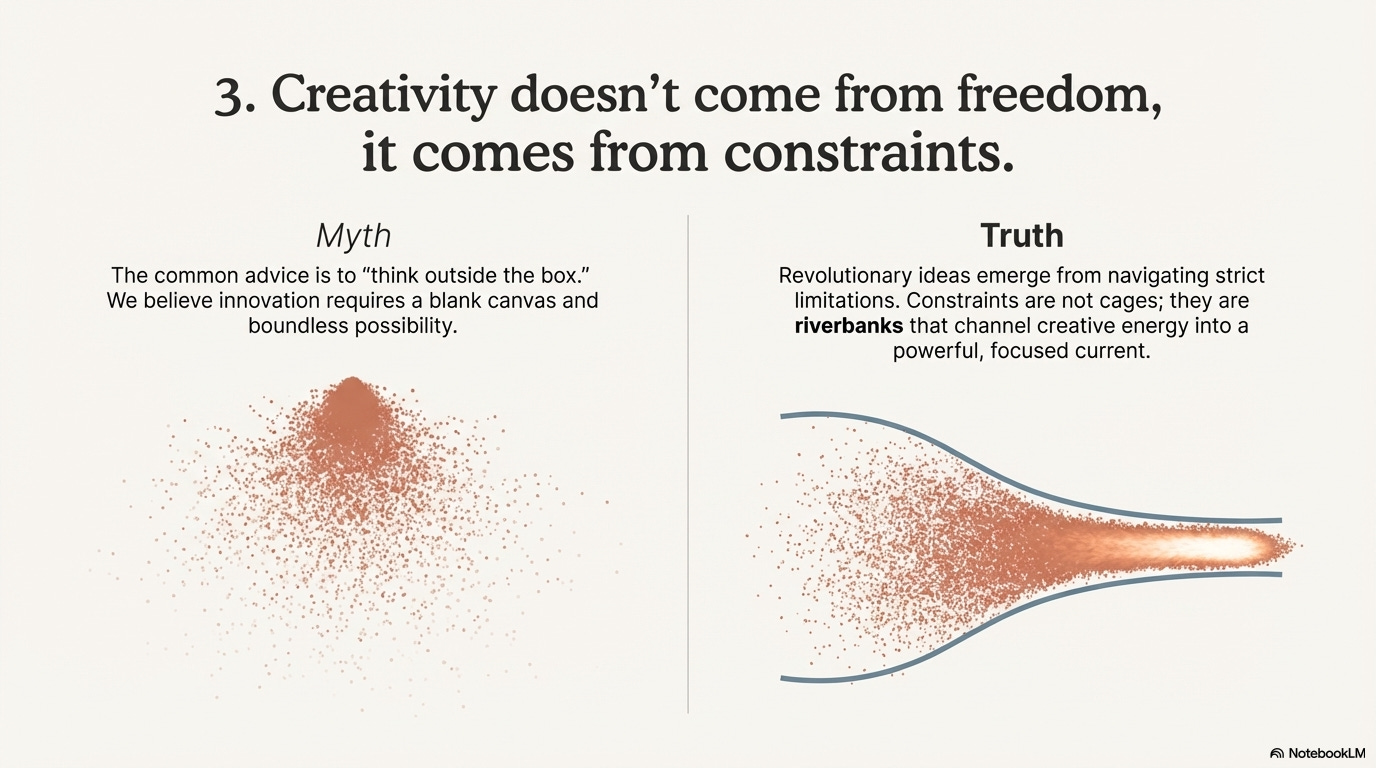
The Myth: The Blank Canvas. The most common advice for being creative is to “think outside the box,” which suggests that true innovation requires boundless freedom and a complete absence of rules.
The Truth: Creativity Thrives on Constraints. History and cognitive science reveal that revolutionary ideas emerge not from boundless possibility, but from navigating strict limitations. Constraints are not cages; they are riverbanks. Too much freedom scatters creative energy, where it pools and stagnates. Constraints channel that same energy into a powerful, focused current
The Deeper Dive: Constraints in Action. The engineers of Apollo 13 demonstrated this principle under the most extreme pressure. Faced with a failing CO₂ filter, they could only use the items available on the spacecraft: plastic bags, duct tape, and socks. This severe limitation was not an obstacle to their creativity; it was the very condition that made their life-saving solution possible.
This principle appears across all creative fields:
• Haiku poets work within the strict constraint of 17 syllables.
• Sonneteers must adhere to 14 lines and rigid rhyme schemes.
• Architects design within the non-negotiable limits of budgets, building codes, and the laws of physics.
The Practical Insight. Stop seeking a blank canvas and start deliberately defining your constraints. Frame limits on time, resources, or available tools not as obstacles, but as creative partners that force the discovery of new paths.
This principle of strategic limitation leads to another counter-intuitive truth: that the path to greater knowledge lies not in accumulation, but in strategic release.
Myth #4: A Better Brain Is One That Remembers Everything
The Myth: The Fear of Forgetting. Modern Personal Knowledge Management (PKM) systems often tap into a deep-seated anxiety: the “Fear of Forgetting (FoF).” We are driven to capture and hoard every thought and article, fearing that if we lose a note, we lose a part of our intellectual identity.
The Truth: Wisdom Comes from Intentional Forgetting. This digital hoarding is counterproductive. The system stops being a tool for thinking and becomes a “prosthetic self,” where deleting notes feels like self-amputation. Real understanding and wisdom emerge from curation and intentional forgetting, not from mindless collection.
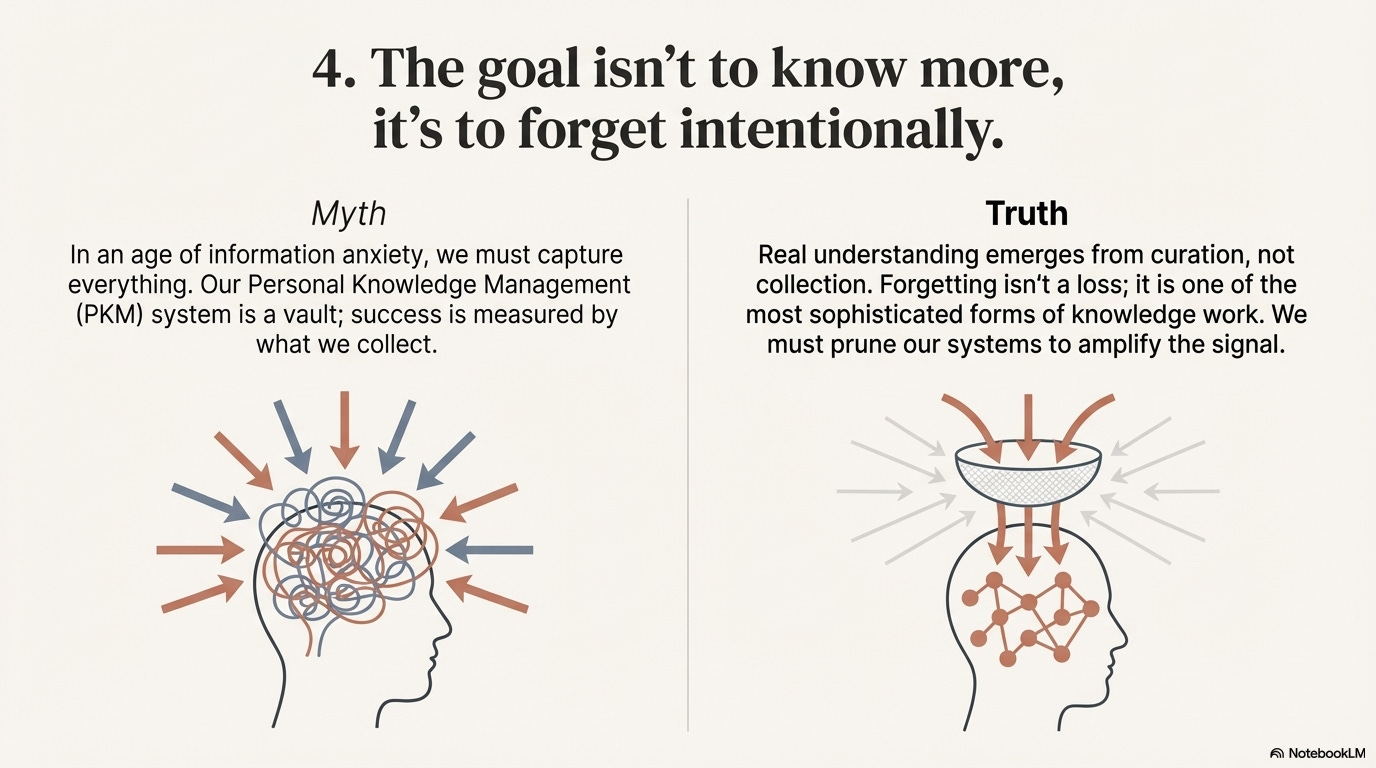
The Deeper Dive: Why Digital Hoarding Fails. The reason this fails is explained by the Extended Mind Hypothesis. For a tool to function as a true cognitive extension, it must be trustworthy and accessible. A cluttered system violates these conditions:
• Destroys trust: When your system is full of noise, finding what you need becomes an unreliable lottery.
• Eliminates accessibility: You cannot automatically access information because you first have to sift through a mountain of irrelevant notes.
• Erases endorsement: You constantly encounter orphaned thoughts from a past self you no longer recognize or agree with, breaking the link between you and your system.
The Practical Insight. Your mind is the knowledge engine, not your note-taking system. The goal is not to collect everything, but to curate what is essential. Intellectual maturity is measured not by what you can accumulate, but by what you recognize you no longer need. Forgetting isn’t a loss; it is one of the most sophisticated forms of knowledge work.
The discipline of pruning our external mind to amplify signal is the perfect training for the next great cognitive challenge: learning to partner with an intelligence that is all signal.
Myth #5: It’s Humans vs. AI
The Myth: The Great Race. As artificial intelligence grows more capable, the common question is rooted in fear and competition: “Will AI replace us?” This frames the relationship as a race for superiority or a spot in a hierarchy.
The Truth: The Hybrid Mind. This framing misses the more profound reality. We are not in a race against machines; we are participating in a creative synthesis that is forming a new kind of “hybrid mind” where human and artificial intelligence work in partnership.
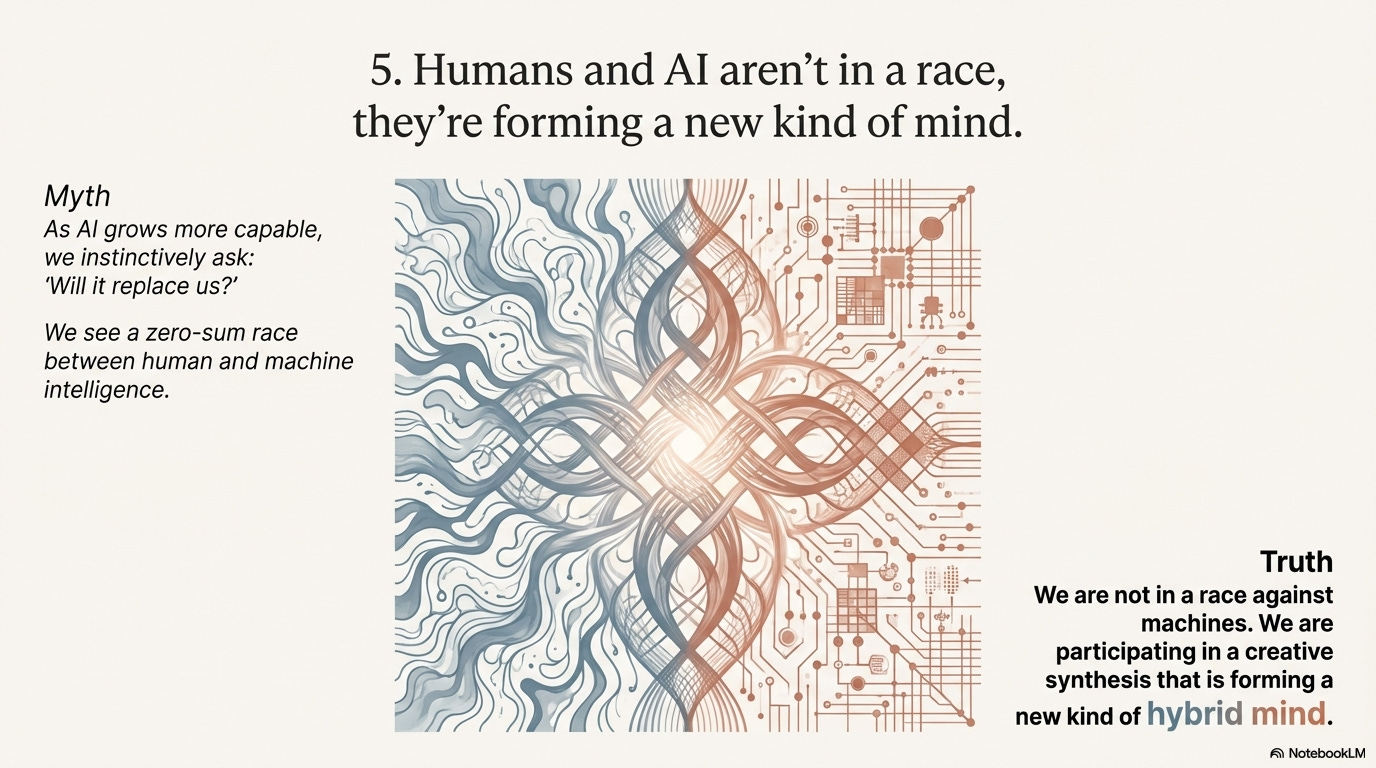
The Deeper Dive: How We Think Together. This is already happening. A chess grandmaster working with an AI engine doesn’t just follow its moves; she develops new intuitions and brings contextual judgment the machine lacks. Together, they play a game of chess neither could play alone. The same dynamic appears with radiologists and diagnostic AI, or writers and language models. The philosopher Alfred North Whitehead captured the essence of this synthesis:
“The many become one, and are increased by one.”
A new, more capable entity emerges because creativity thrives on the tension between different modes of thought. AI excels at the how of execution—pattern recognition and exploring possibilities—while humans dwell in the why that gives direction—meaning, purpose, and judgment.
The “How” vs. The “Why”
AI represents the “How.” It is characterized by the mechanics of execution, the tireless exploration of possibilities, and the ability to recognize patterns across vast datasets. Conversely, humans represent the “Why.” We provide the direction to the work, dwell in meaning and purpose, and supply the essential context and judgment required to interpret AI’s output.
The Practical Insight. The most crucial takeaway is this: the fact that AI thinks differently from us is not a flaw to be corrected, but the very source of creative advance. The goal is not to compete with AI at its own game, but to collaborate with it to achieve things neither could accomplish alone.
These five truths combine to form a new, more accurate and powerful model for the mind.
Conclusion: From Understanding to Practice
Taken together, these truths reveal a mind that is not a passive receiver of facts, but an active, predictive engine that grows through resistance, finds focus through limits, gains wisdom through release, and achieves its highest potential in partnership with new forms of intelligence.
Understanding these principles is only the beginning. The real work lies in putting them into practice.
Putting It Into Practice
Deliberately seek productive struggle. Don’t avoid the feeling of mental strain; recognize it as the feeling of learning.
Embrace constraints as creative tools. Instead of seeking a blank canvas, define your limits to focus your energy.
Regularly prune external knowledge systems. Treat your notes not as a museum for collection, but as a workshop that must be kept clean and functional.
Approach AI as a collaborator, not a threat. Focus on what new forms of thought become possible when you work in partnership.
The age of AI does not diminish the importance of human cognition; it raises the stakes. Those who understand how their own minds work—and how to extend them through partnership—will be the ones who thrive.